You are here: Charity Retail >>Full text
Tom Brown's Schooldays, by Thomas Hughes
Charity Retail43219 people viewed
SummaryTOM BROWN'S SCHOOLDAYS By Thomas Hughes Illustrated by Louis RheadOriginalOriginalOriginalOrig ...
TOM BROWN'S SCHOOLDAYS
By Thomas Hughes
Illustrated by Louis Rhead
Original
Original
Original
Original
CONTENTS
PART I.
CHAPTER I—THE BROWN FAMILY
CHAPTER II—THE “VEAST.”
CHAPTER III—SUNDRY WARS AND ALLIANCES.
CHAPTER IV—THE STAGE COACH.
CHAPTER V—RUGBY AND FOOTBALL.
CHAPTER VI—AFTER THE MATCH.
CHAPTER VII—SETTLING TO THE COLLAR.
CHAPTER VIII—THE WAR OF INDEPENDENCE.
CHAPTER IX—A CHAPTER OF ACCIDENTS.
PART II.
CHAPTER I—HOW THE TIDE TURNED.
CHAPTER II—THE NEW BOY.
CHAPTER III—ARTHUR MAKES A FRIEND.
CHAPTER IV—THE BIRD-FANCIERS.
CHAPTER V—THE FIGHT:
CHAPTER VI—FEVER IN THE SCHOOL.
CHAPTER VII—HARRY EAST'S DILEMMAS AND DELIVERANCES.
CHAPTER VIII—TOM BROWN'S LAST MATCH.
CHAPTER IX—FINIS.
Original
Original

Original
 Original
T is kids sleds for 4 year olds under 20 dollarsnot often that in later years one finds any book as good as oneremembers it from one's youth; but it has been my interesting experienceto find the story of Tom Brown's School Days even better than I oncethought it, say, fifty years ago; not only better, but more charming,more kindly, manlier, truer, realler. So far as I have been able to notethere is not a moment of snobbishness in it, or meanness of whateversort. Of course it is of its period, the period which people call MiddleVictorian because the great Queen was then nearly at the end ofthe first half of her long reign, and not because she personallycharacterized the mood of arts, of letters, of morals then prevalent.
The author openly preaches and praises himself for preaching; he doesnot hesitate to slip into the drama and deliver a sermon; he talks thestory out with many self-interruptions and excursions; he knows nothingof the modern method of letting it walk along on its own legs, butis always putting his hands under its arms and helping it, or his armacross its shoulder and caressing it. In all this, which I think wrong,he is probably doing quite right for the boys who formed and will alwaysform the greatest number of his readers; boys like to have things fullyexplained and commentated, whether they are grown up or not. In muchelse, in what I will not say are not the great matters, he is altogetherright. By precept and by example he teaches boys to be good, that is, tobe true, honest, clean-minded and clean-mouthed, kind and thoughtful. Heforgives them the follies of their youth, but makes them see that theyare follies.
I suppose that American boys' schools are fashioned largely on whatthe English call their public schools; and so far as they emulate thedemocratic spirit of the English schools, with their sense of equalityand their honor of personal worth, the American schools cannot betoo like them. I have heard that some of our schools are cultures ofunrepublican feeling, and that the meaner little souls in them maketheir account of what families it will be well to know after they leaveschool and restrict their school friendships accordingly, but I am notcertain this is true. What I am certain of is that our school-boys canlearn nothing of such baseness from the warm-hearted and large-mindedman who wrote Tom Brown's School Days. He was one of our best friendsin the Civil War, when we sorely needed friends in England, and it washis magnanimous admiration which made our great patriotic poet known toa public which had scarcely heard of James Russell Lowell before.
But the manners and customs painted in this book are the manners andcustoms of the middle eighteen-fifties. It appears from its witness thatEnglish school-boys then freely drank beer and ale, and fought out theirquarrels like prize-fighters with their naked fists, though the beer wasallowed and the fighting disallowed by the school. Now, however, eventhe ruffians of the ring put on gloves, and probably the quarrels of ourown schoolboys are not fought out even with gloves. Beer and ale mustalways have been as clandestine vices in our schools as pitched battleswith fists in English schools; water was the rule, but probably if anAmerican boy now went to an English school he would not have to teach byhis singular example that water was a better drink for boys than beer.
Our author had apparently no misgiving as to the beer; he does not blinkit or defend it; beer was too merely a matter of course; but he makesa set argument for fighting, based upon the good old safe groundthat there always had been fighting. Even in the heyday of muscularChristianity it seems that there must have been some question offighting and it was necessary to defend it on the large and littlescale, and his argument as to fisticuffs defeats itself. Concerning war,which we are now hoping that we see the beginning of the end of, he needonly have looked into The Biglow Papers to find his idolized Lowellsaying:
“Ez fur war I call it murder; There ye hev it plain an' flat; An' I don't want to go no furder Then my Testament fur that.”
I feel it laid upon me in commending this book to a new generation ofreaders, to guard them, so far as I may, against such errors of it.Possibly it might have been cleansed of them by editing, but that wouldhave taken much of the life out of it, and would have been a grievouswrong to the author. They must remain a part of literature as many otherregrettable things remain. They are a part of history, a color ofthe contemporary manners, and an excellently honest piece ofself-portraiture. They are as the wart on Cromwell's face, and areessentially an element of a most Cromwellian genius. It was Puritanism,Macaulay says, that stamped with its ideal the modern English gentlemanin dress and manner, and Puritanism has stamped the modern Englishman,the liberal, the radical, in morals. The author of Toni Brown wasstrongly of the English Church and the English State, but of thebroad church and of the broad state. He was not only the best sort ofEnglishman, but he was the making of the best sort of American; and theAmerican father can trust the American boy with his book, and fear nohurt to his republicanism, still less his democracy.
It is full of the delight in nature and human nature, unpatronized andunsentimentalized. From his earliest boyhood up Tom Brown is the freeand equal comrade of other decent boys of whatever station, and heranges the woods, the fields, the streams with the joy in the sylvanlife which is the birthright of all the boys born within reach of them.The American school-boy of this generation will as freshly taste thepleasure of the school life at Rugby as the American school-boys of thetwo generations past, and he can hardly fail to rise from it with thenoble intentions, the magnanimous ambitions which only good books caninspire.
W. D. Howells.
Original
PART I.
Original
CHAPTER I—THE BROWN FAMILY
“I'm the Poet of White Horse Vale, sir, With liberal notions under my cap.”—Ballad
 Original
he Browns have become illustrious by the pen of Thackeray and the pencil of Doyle, within the memory of the young gentlemen who are now matriculating at the universities. Notwithstanding the well-merited but late fame which has now fallen upon them, any one at all acquainted with the family must feel that much has yet to be written and said before the British nation will be properly sensible of how much of its greatness it owes to the Browns. For centuries, in their quiet, dogged, homespun way, they have been subduing the earth in most English counties, and leaving their mark in American forests and Australian uplands. Wherever the fleets and armies of England have won renown, there stalwart sons of the Browns have done yeomen's work. With the yew bow and cloth-yard shaft at Cressy and Agincourt—with the brown bill and pike under the brave Lord Willoughby—with culverin and demi-culverin against Spaniards and Dutchmen—with hand-grenade and sabre, and musket and bayonet, under Rodney and St. Vincent, Wolfe and Moore, Nelson and Wellington, they have carried their lives in their hands, getting hard knocks and hard work in plenty—which was on the whole what they looked for, and the best thing for them—and little praise or pudding, which indeed they, and most of us, are better without. Talbots and Stanleys, St. Maurs, and such-like folk, have led armies and made laws time out of mind; but those noble families would be somewhat astounded—if the accounts ever came to be fairly taken—to find how small their work for England has been by the side of that of the Browns.
These latter, indeed, have, until the present generation, rarely been sung by poet, or chronicled by sage. They have wanted their sacer vates, having been too solid to rise to the top by themselves, and not having been largely gifted with the talent of catching hold of, and holding on tight to, whatever good things happened to be going—the foundation of the fortunes of so many noble families. But the world goes on its way, and the wheel turns, and the wrongs of the Browns, like other wrongs, seem in a fair way to get righted. And this present writer, having for many years of his life been a devout Brown-worshipper, and, moreover, having the honour of being nearly connected with an eminently respectable branch of the great Brown family, is anxious, so far as in him lies, to help the wheel over, and throw his stone on to the pile.
However, gentle reader, or simple reader, whichever you may be, lest you should be led to waste your precious time upon these pages, I make so bold as at once to tell you the sort of folk you'll have to meet and put up with, if you and I are to jog on comfortably together. You shall hear at once what sort of folk the Browns are—at least my branch of them; and then, if you don't like the sort, why, cut the concern at once, and let you and I cry quits before either of us can grumble at the other.
In the first place, the Browns are a fighting family. One may question their wisdom, or wit, or beauty, but about their fight there can be no question. Wherever hard knocks of any kind, visible or invisible, are going; there the Brown who is nearest must shove in his carcass. And these carcasses, for the most part, answer very well to the characteristic propensity: they are a squareheaded and snake-necked generation, broad in the shoulder, deep in the chest, and thin in the flank, carrying no lumber. Then for clanship, they are as bad as Highlanders; it is amazing the belief they have in one another. With them there is nothing like the Browns, to the third and fourth generation. “Blood is thicker than water,” is one of their pet sayings. They can't be happy unless they are always meeting one another. Never were such people for family gatherings; which, were you a stranger, or sensitive, you might think had better not have been gathered together. For during the whole time of their being together they luxuriate in telling one another their minds on whatever subject turns up; and their minds are wonderfully antagonistic, and all their opinions are downright beliefs. Till you've been among them some time and understand them, you can't think but that they are quarrelling. Not a bit of it. They love and respect one another ten times the more after a good set family arguing bout, and go back, one to his curacy, another to his chambers, and another to his regiment, freshened for work, and more than ever convinced that the Browns are the height of company.
This family training, too, combined with their turn for combativeness, makes them eminently quixotic. They can't let anything alone which they think going wrong. They must speak their mind about it, annoying all easy-going folk, and spend their time and money in having a tinker at it, however hopeless the job. It is an impossibility to a Brown to leave the most disreputable lame dog on the other side of a stile. Most other folk get tired of such work. The old Browns, with red faces, white whiskers, and bald heads, go on believing and fighting to a green old age. They have always a crotchet going, till the old man with the scythe reaps and garners them away for troublesome old boys as they are.
And the most provoking thing is, that no failures knock them up, or make them hold their hands, or think you, or me, or other sane people in the right. Failures slide off them like July rain off a duck's back feathers. Jem and his whole family turn out bad, and cheat them one week, and the next they are doing the same thing for Jack; and when he goes to the treadmill, and his wife and children to the workhouse, they will be on the lookout for Bill to take his place.
However, it is time for us to get from the general to the particular; so, leaving the great army of Browns, who are scattered over the whole empire on which the sun never sets, and whose general diffusion I take to be the chief cause of that empire's stability; let us at once fix our attention upon the small nest of Browns in which our hero was hatched, and which dwelt in that portion of the royal county of Berks which is called the Vale of White Horse.
Most of you have probably travelled down the Great Western Railway as far as Swindon. Those of you who did so with their eyes open have been aware, soon after leaving the Didcot station, of a fine range of chalk hills running parallel with the railway on the left-hand side as you go down, and distant some two or three miles, more or less, from the line. The highest point in the range is the White Horse Hill, which you come in front of just before you stop at the Shrivenham station. If you love English scenery, and have a few hours to spare, you can't do better, the next time you pass, than stop at the Farringdon Road or Shrivenham station, and make your way to that highest point. And those who care for the vague old stories that haunt country-sides all about England, will not, if they are wise, be content with only a few hours' stay; for, glorious as the view is, the neighbourhood is yet more interesting for its relics of bygone times. I only know two English neighbourhoods thoroughly, and in each, within a circle of five miles, there is enough of interest and beauty to last any reasonable man his life. I believe this to be the case almost throughout the country, but each has a special attraction, and none can be richer than the one I am speaking of and going to introduce you to very particularly, for on this subject I must be prosy; so those that don't care for England in detail may skip the chapter.
O young England! young England! you who are born into these racing railroad times, when there's a Great Exhibition, or some monster sight, every year, and you can get over a couple of thousand miles of ground for three pound ten in a five-weeks' holiday, why don't you know more of your own birthplaces? You're all in the ends of the earth, it seems to me, as soon as you get your necks out of the educational collar, for midsummer holidays, long vacations, or what not—going round Ireland, with a return ticket, in a fortnight; dropping your copies of Tennyson on the tops of Swiss mountains; or pulling down the Danube in Oxford racing boats. And when you get home for a quiet fortnight, you turn the steam off, and lie on your backs in the paternal garden, surrounded by the last batch of books from Mudie's library, and half bored to death. Well, well! I know it has its good side. You all patter French more or less, and perhaps German; you have seen men and cities, no doubt, and have your opinions, such as they are, about schools of painting, high art, and all that; have seen the pictures of Dresden and the Louvre, and know the taste of sour krout. All I say is, you don't know your own lanes and woods and fields. Though you may be choke-full of science, not one in twenty of you knows where to find the wood-sorrel, or bee-orchis, which grow in the next wood, or on the down three miles off, or what the bog-bean and wood-sage are good for. And as for the country legends, the stories of the old gable-ended farmhouses, the place where the last skirmish was fought in the civil wars, where the parish butts stood, where the last highwayman turned to bay, where the last ghost was laid by the parson, they're gone out of date altogether.
Now, in my time, when we got home by the old coach, which put us down at the cross-roads with our boxes, the first day of the holidays, and had been driven off by the family coachman, singing “Dulce Domum” at the top of our voices, there we were, fixtures, till black Monday came round. We had to cut out our own amusements within a walk or a ride of home. And so we got to know all the country folk and their ways and songs and stories by heart, and went over the fields and woods and hills, again and again, till we made friends of them all. We were Berkshire, or Gloucestershire, or Yorkshire boys; and you're young cosmopolites, belonging to all countries and no countries. No doubt it's all right; I dare say it is. This is the day of large views, and glorious humanity, and all that; but I wish back-sword play hadn't gone out in the Vale of White Horse, and that that confounded Great Western hadn't carried away Alfred's Hill to make an embankment.
But to return to the said Vale of White Horse, the country in which the first scenes of this true and interesting story are laid. As I said, the Great Western now runs right through it, and it is a land of large, rich pastures bounded by ox-fences, and covered with fine hedgerow timber, with here and there a nice little gorse or spinney, where abideth poor Charley, having no other cover to which to betake himself for miles and miles, when pushed out some fine November morning by the old Berkshire. Those who have been there, and well mounted, only know how he and the stanch little pack who dash after him—heads high and sterns low, with a breast-high scent—can consume the ground at such times. There being little ploughland, and few woods, the Vale is only an average sporting country, except for hunting. The villages are straggling, queer, old-fashioned places, the houses being dropped down without the least regularity, in nooks and out-of-the-way corners, by the sides of shadowy lanes and footpaths, each with its patch of garden. They are built chiefly of good gray stone, and thatched; though I see that within the last year or two the red-brick cottages are multiplying, for the Vale is beginning to manufacture largely both bricks and tiles. There are lots of waste ground by the side of the roads in every village, amounting often to village greens, where feed the pigs and ganders of the people; and these roads are old-fashioned, homely roads, very dirty and badly made, and hardly endurable in winter, but still pleasant jog-trot roads running through the great pasture-lands, dotted here and there with little clumps of thorns, where the sleek kine are feeding, with no fence on either side of them, and a gate at the end of each field, which makes you get out of your gig (if you keep one), and gives you a chance of looking about you every quarter of a mile.
One of the moralists whom we sat under in our youth—was it the great Richard Swiveller, or Mr. Stiggins—says, “We are born in a vale, and must take the consequences of being found in such a situation.” These consequences I, for one, am ready to encounter. I pity people who weren't born in a vale. I don't mean a flat country; but a vale—that is, a flat country bounded by hills. The having your hill always in view if you choose to turn towards him—that's the essence of a vale. There he is for ever in the distance, your friend and companion. You never lose him as you do in hilly districts.
And then what a hill is the White Horse Hill! There it stands right up above all the rest, nine hundred feet above the sea, and the boldest, bravest shape for a chalk hill that you ever saw. Let us go up to the top of him, and see what is to be found there. Ay, you may well wonder and think it odd you never heard of this before; but wonder or not, as you please, there are hundreds of such things lying about England, which wiser folk than you know nothing of, and care nothing for. Yes, it's a magnificent Roman camp, and no mistake, with gates and ditch and mounds, all as complete as it was twenty years after the strong old rogues left it. Here, right up on the highest point, from which they say you can see eleven counties, they trenched round all the table-land, some twelve or fourteen acres, as was their custom, for they couldn't bear anybody to overlook them, and made their eyrie. The ground falls away rapidly on all sides. Was there ever such turf in the whole world? You sink up to your ankles at every step, and yet the spring of it is delicious. There is always a breeze in the “camp,” as it is called; and here it lies, just as the Romans left it, except that cairn on the east side, left by her Majesty's corps of sappers and miners the other day, when they and the engineer officer had finished their sojourn there, and their surveys for the ordnance map of Berkshire. It is altogether a place that you won't forget, a place to open a man's soul, and make him prophesy, as he looks down on that great Vale spread out as the garden of the Lord before him, and wave on wave of the mysterious downs behind, and to the right and left the chalk hills running away into the distance, along which he can trace for miles the old Roman road, “the Ridgeway” (“the Rudge,” as the country folk call it), keeping straight along the highest back of the hills—such a place as Balak brought Balaam to, and told him to prophesy against the people in the valley beneath. And he could not, neither shall you, for they are a people of the Lord who abide there.
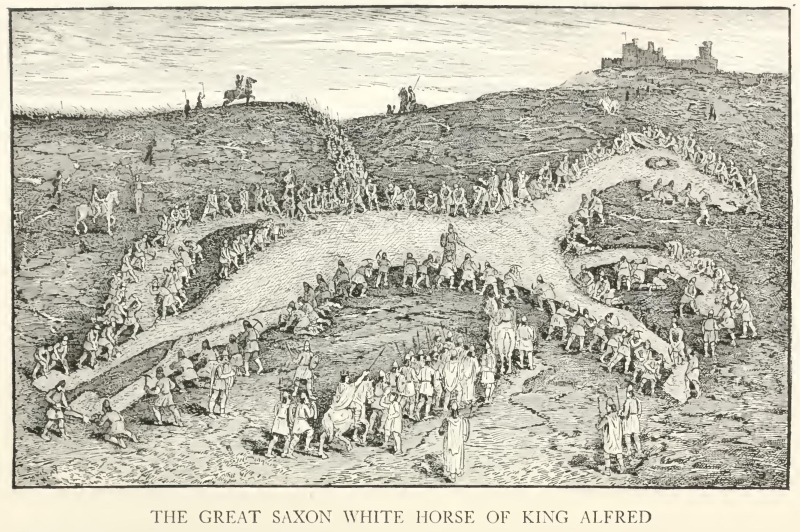
And now we leave the camp, and descend towards the west, and are on the Ashdown. We are treading on heroes. It is sacred ground for Englishmen—more sacred than all but one or two fields where their bones lie whitening. For this is the actual place where our Alfred won his great battle, the battle of Ashdown (“Aescendum” in the chroniclers), which broke the Danish power, and made England a Christian land. The Danes held the camp and the slope where we are standing—the whole crown of the hill, in fact. “The heathen had beforehand seized the higher ground,” as old Asser says, having wasted everything behind them from London, and being just ready to burst down on the fair Vale, Alfred's own birthplace and heritage. And up the heights came the Saxons, as they did at the Alma. “The Christians led up their line from the lower ground. There stood also on that same spot a single thorn-tree, marvellous stumpy (which we ourselves with our very own eyes have seen).” Bless the old chronicler! Does he think nobody ever saw the “single thorn-tree” but himself? Why, there it stands to this very day, just on the edge of the slope, and I saw it not three weeks since—an old single thorn-tree, “marvellous stumpy.” At least, if it isn't the same tree it ought to have been, for it's just in the place where the battle must have been won or lost—“around which, as I was saying, the two lines of foemen came together in battle with a huge shout. And in this place one of the two kings of the heathen and five of his earls fell down and died, and many thousands of the heathen side in the same place.” * After which crowning mercy, the pious king, that there might never be wanting a sign and a memorial to the country-side, carved out on the northern side of the chalk hill, under the camp, where it is almost precipitous, the great Saxon White Horse, which he who will may see from the railway, and which gives its name to the Vale, over which it has looked these thousand years and more.
* “Pagani editiorem Iocum praeoccupaverant. Christiani ab inferiori loco aciem dirigebant. Erat quoque in eodem loco unica spinosa arbor, brevis admodum (quam nos ipsi nostris propriis oculis vidimus). Circa quam ergo hostiles inter se acies cum ingenti clamore hostiliter conveniunt. Quo in loco alter de duobus Paganorum regibus et quinque comites occisi occubuerunt, et multa millia Paganae partis in eodem loco. Cecidit illic ergo Boegsceg Rex, et Sidroc ille senex comes, et Sidroc Junior comes, et Obsbern comes,” etc.— Annales Rerum Gestarum AElfredi Magni, Auctore Asserio. Recensuit Franciscus Wise. Oxford, 1722, p.23.
Original
Right down below the White Horse is a curious deep and broad gully called “the Manger,” into one side of which the hills fall with a series of the most lovely sweeping curves, known as “the Giant's Stairs.” They are not a bit like stairs, but I never saw anything like them anywhere else, with their short green turf, and tender bluebells, and gossamer and thistle-down gleaming in the sun and the sheep-paths running along their sides like ruled lines.
The other side of the Manger is formed by the Dragon's Hill, a curious little round self-confident fellow, thrown forward from the range, utterly unlike everything round him. On this hill some deliverer of mankind—St. George, the country folk used to tell me—killed a dragon. Whether it were St. George, I cannot say; but surely a dragon was killed there, for you may see the marks yet where his blood ran down, and more by token the place where it ran down is the easiest way up the hillside.
Passing along the Ridgeway to the west for about a mile, we come to a little clump of young beech and firs, with a growth of thorn and privet underwood. Here you may find nests of the strong down partridge and peewit, but take care that the keeper isn't down upon you; and in the middle of it is an old cromlech, a huge flat stone raised on seven or eight others, and led up to by a path, with large single stones set up on each side. This is Wayland Smith's cave, a place of classic fame now; but as Sir Walter has touched it, I may as well let it alone, and refer you to “Kenilworth” for the legend.
The thick, deep wood which you see in the hollow, about a mile off, surrounds Ashdown Park, built by Inigo Jones. Four broad alleys are cut through the wood from circumference to centre, and each leads to one face of the house. The mystery of the downs hangs about house and wood, as they stand there alone, so unlike all around, with the green slopes studded with great stones just about this part, stretching away on all sides. It was a wise Lord Craven, I think, who pitched his tent there.
Passing along the Ridgeway to the east, we soon come to cultivated land. The downs, strictly so called, are no more. Lincolnshire farmers have been imported, and the long, fresh slopes are sheep-walks no more, but grow famous turnips and barley. One of these improvers lives over there at the “Seven Barrows” farm, another mystery of the great downs. There are the barrows still, solemn and silent, like ships in the calm sea, the sepulchres of some sons of men. But of whom? It is three miles from the White Horse—too far for the slain of Ashdown to be buried there. Who shall say what heroes are waiting there? But we must get down into the Vale again, and so away by the Great Western Railway to town, for time and the printer's devil press, and it is a terrible long and slippery descent, and a shocking bad road. At the bottom, however, there is a pleasant public; whereat we must really take a modest quencher, for the down air is provocative of thirst. So we pull up under an old oak which stands before the door.
“What is the name of your hill, landlord?”
“Blawing STWUN Hill, sir, to be sure.”
[READER. “Stuym?”
AUTHOR: “Stone, stupid—the Blowing Stone.”]
“And of your house? I can't make out the sign.”
“Blawing Stwun, sir,” says the landlord, pouring out his old ale from a Toby Philpot jug, with a melodious crash, into the long-necked glass.
“What queer names!” say we, sighing at the end of our draught, and holding out the glass to be replenished.
“Bean't queer at all, as I can see, sir,” says mine host, handing back our glass, “seeing as this here is the Blawing Stwun, his self,” putting his hand on a square lump of stone, some three feet and a half high, perforated with two or three queer holes, like petrified antediluvian rat-holes, which lies there close under the oak, under our very nose. We are more than ever puzzled, and drink our second glass of ale, wondering what will come next. “Like to hear un, sir?” says mine host, setting down Toby Philpot on the tray, and resting both hands on the “Stwun.” We are ready for anything; and he, without waiting for a reply, applies his mouth to one of the ratholes. Something must come of it, if he doesn't burst. Good heavens! I hope he has no apoplectic tendencies. Yes, here it comes, sure enough, a gruesome sound between a moan and a roar, and spreads itself away over the valley, and up the hillside, and into the woods at the back of the house, a ghost-like, awful voice. “Um do say, sir,” says mine host, rising purple-faced, while the moan is still coming out of the Stwun, “as they used in old times to warn the country-side by blawing the Stwun when the enemy was a-comin', and as how folks could make un heered then for seven mile round; leastways, so I've heered Lawyer Smith say, and he knows a smart sight about them old times.” We can hardly swallow Lawyer Smith's seven miles; but could the blowing of the stone have been a summons, a sort of sending the fiery cross round the neighbourhood in the old times? What old times? Who knows? We pay for our beer, and are thankful.
“And what's the name of the village just below, landlord?”
“Kingstone Lisle, sir.”
“Fine plantations you've got here?”
“Yes, sir; the Squire's 'mazing fond of trees and such like.”
“No wonder. He's got some real beauties to be fond of. Good-day, landlord.”
“Good-day, sir, and a pleasant ride to 'ee.”
And now, my boys, you whom I want to get for readers, have you had enough? Will you give in at once, and say you're convinced, and let me begin my story, or will you have more of it? Remember, I've only been over a little bit of the hillside yet—what you could ride round easily on your ponies in an hour. I'm only just come down into the Vale, by Blowing Stone Hill; and if I once begin about the Vale, what's to stop me? You'll have to hear all about Wantage, the birthplace of Alfred, and Farringdon, which held out so long for Charles the First (the Vale was near Oxford, and dreadfully malignant—full of Throgmortons, Puseys, and Pyes, and such like; and their brawny retainers). Did you ever read Thomas Ingoldsby's “Legend of Hamilton Tighe”? If you haven't, you ought to have. Well, Farringdon is where he lived, before he went to sea; his real name was Hamden Pye, and the Pyes were the great folk at Farringdon. Then there's Pusey. You've heard of the Pusey horn, which King Canute gave to the Puseys of that day, and which the gallant old squire, lately gone to his rest (whom Berkshire freeholders turned out of last Parliament, to their eternal disgrace, for voting according to his conscience), used to bring out on high days, holidays, and bonfire nights. And the splendid old cross church at Uffington, the Uffingas town. How the whole countryside teems with Saxon names and memories! And the old moated grange at Compton, nestled close under the hillside, where twenty Marianas may have lived, with its bright water-lilies in the moat, and its yew walk, “the cloister walk,” and its peerless terraced gardens. There they all are, and twenty things beside, for those who care about them, and have eyes. And these are the sort of things you may find, I believe, every one of you, in any common English country neighbourhood.
Will you look for them under your own noses, or will you not? Well, well, I've done what I can to make you; and if you will go gadding over half Europe now, every holidays, I can't help it. I was born and bred a west-country man, thank God! a Wessex man, a citizen of the noblest Saxon kingdom of Wessex, a regular “Angular Saxon,” the very soul of me adscriptus glebae. There's nothing like the old country-side for me, and no music like the twang of the real old Saxon tongue, as one gets it fresh from the veritable chaw in the White Horse Vale; and I say with “Gaarge Ridler,” the old west-country yeoman,—
“Throo aall the waarld owld Gaarge would bwoast, Commend me to merry owld England mwoast; While vools gwoes prating vur and nigh, We stwops at whum, my dog and I.”
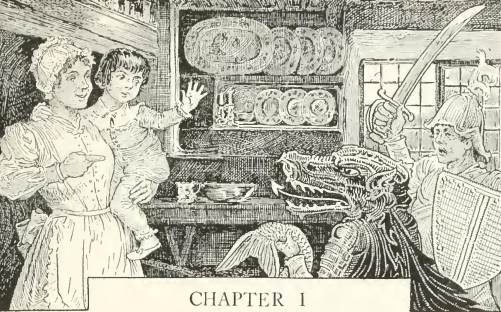
Here, at any rate, lived and stopped at home Squire Brown, J.P. for the county of Berks, in a village near the foot of the White Horse range. And here he dealt out justice and mercy in a rough way, and begat sons and daughters, and hunted the fox, and grumbled at the badness of the roads and the times. And his wife dealt out stockings, and calico shirts, and smock frocks, and comforting drinks to the old folks with the “rheumatiz,” and good counsel to all; and kept the coal and clothes' clubs going, for yule-tide, when the bands of mummers came round, dressed out in ribbons and coloured paper caps, and stamped round the Squire's kitchen, repeating in true sing-song vernacular the legend of St. George and his fight, and the ten-pound doctor, who plays his part at healing the Saint—a relic, I believe, of the old Middle-age mysteries. It was the first dramatic representation which greeted the eyes of little Tom, who was brought down into the kitchen by his nurse to witness it, at the mature age of three years. Tom was the eldest child of his parents, and from his earliest babyhood exhibited the family characteristics in great strength. He was a hearty, strong boy from the first, given to fighting with and escaping from his nurse, and fraternizing with all the village boys, with whom he made expeditions all round the neighbourhood. And here, in the quiet old-fashioned country village, under the shadow of the everlasting hills, Tom Brown was reared, and never left it till he went first to school, when nearly eight years of age, for in those days change of air twice a year was not thought absolutely necessary for the health of all her Majesty's lieges.
I have been credibly informed, and am inclined to believe, that the various boards of directors of railway companies, those gigantic jobbers and bribers, while quarrelling about everything else, agreed together some ten years back to buy up the learned profession of medicine, body and soul. To this end they set apart several millions of money, which they continually distribute judiciously among the doctors, stipulating only this one thing, that they shall prescribe change of air to every patient who can pay, or borrow money to pay, a railway fare, and see their prescription carried out. If it be not for this, why is it that none of us can be well at home for a year together? It wasn't so twenty years ago, not a bit of it. The Browns didn't go out of the country once in five years. A visit to Reading or Abingdon twice a year, at assizes or quarter sessions, which the Squire made on his horse with a pair of saddle-bags containing his wardrobe, a stay of a day or two at some country neighbour's, or an expedition to a county ball or the yeomanry review, made up the sum of the Brown locomotion in most years. A stray Brown from some distant county dropped in every now and then; or from Oxford, on grave nag, an old don, contemporary of the Squire; and were looked upon by the Brown household and the villagers with the same sort of feeling with which we now regard a man who has crossed the Rocky Mountains, or launched a boat on the Great Lake in Central Africa. The White Horse Vale, remember, was traversed by no great road—nothing but country parish roads, and these very bad. Only one coach ran there, and this one only from Wantage to London, so that the western part of the Vale was without regular means of moving on, and certainly didn't seem to want them. There was the canal, by the way, which supplied the country-side with coal, and up and down which continually went the long barges, with the big black men lounging by the side of the horses along the towing-path, and the women in bright-coloured handkerchiefs standing in the sterns steering. Standing I say, but you could never see whether they were standing or sitting, all but their heads and shoulders being out of sight in the cozy little cabins which occupied some eight feet of the stern, and which Tom Brown pictured to himself as the most desirable of residences. His nurse told him that those good-natured-looking women were in the constant habit of enticing children into the barges, and taking them up to London and selling them, which Tom wouldn't believe, and which made him resolve as soon as possible to accept the oft-proffered invitation of these sirens to “young master” to come in and have a ride. But as yet the nurse was too much for Tom.
Yet why should I, after all, abuse the gadabout propensities of my countrymen? We are a vagabond nation now, that's certain, for better for worse. I am a vagabond; I have been away from home no less than five distinct times in the last year. The Queen sets us the example: we are moving on from top to bottom. Little dirty Jack, who abides in Clement's Inn gateway, and blacks my boots for a penny, takes his month's hop-picking every year as a matter of course. Why shouldn't he? I'm delighted at it. I love vagabonds, only I prefer poor to rich ones. Couriers and ladies'-maids, imperials and travelling carriages, are an abomination unto me; I cannot away with them. But for dirty Jack, and every good fellow who, in the words of the capital French song, moves about,
“Comme le limacon, Portant tout son bagage, Ses meubles, sa maison,”
on his own back, why, good luck to them, and many a merry roadside adventure, and steaming supper in the chimney corners of roadside inns, Swiss chalets, Hottentot kraals, or wherever else they like to go. So, having succeeded in contradicting myself in my first chapter (which gives me great hopes that you will all go on, and think me a good fellow notwithstanding my crotchets), I shall here shut up for the present, and consider my ways; having resolved to “sar' it out,” as we say in the Vale, “holus bolus” just as it comes, and then you'll probably get the truth out of me.
Original
CHAPTER II—THE “VEAST.”
“And the King commandeth and forbiddeth, that from henceforth neither fairs nor markets be kept in Churchyards, for the honour of the Church.”—STATUTES : 13 Edw. I. Stat. II. cap. vi.
 Original
s that venerable and learned poet (whose voluminous works we all think it the correct thing to admire and talk about, but don't read often) most truly says, “The child is father to the man;” a fortiori, therefore, he must be father to the boy. So as we are going at any rate to see Tom Brown through his boyhood, supposing we never get any farther (which, if you show a proper sense of the value of this history, there is no knowing but what we may), let us have a look at the life and environments of the child in the quiet country village to which we were introduced in the last chapter.
Tom, as has been already said, was a robust and combative urchin, and at the age of four began to struggle against the yoke and authority of his nurse. That functionary was a good-hearted, tearful, scatter-brained girl, lately taken by Tom's mother, Madam Brown, as she was called, from the village school to be trained as nurserymaid. Madam Brown was a rare trainer of servants, and spent herself freely in the profession; for profession it was, and gave her more trouble by half than many people take to earn a good income. Her servants were known and sought after for miles round. Almost all the girls who attained a certain place in the village school were taken by her, one or two at a time, as housemaids, laundrymaids, nurserymaids, or kitchenmaids, and after a year or two's training were started in life amongst the neighbouring families, with good principles and wardrobes. One of the results of this system was the perpetual despair of Mrs. Brown's cook and own maid, who no sooner had a notable girl made to their hands than missus was sure to find a good place for her and send her off, taking in fresh importations from the school. Another was, that the house was always full of young girls, with clean, shining faces, who broke plates and scorched linen, but made an atmosphere of cheerful, homely life about the place, good for every one who came within its influence. Mrs. Brown loved young people, and in fact human creatures in general, above plates and linen. They were more like a lot of elder children than servants, and felt to her more as a mother or aunt than as a mistress.
Tom's nurse was one who took in her instruction very slowly—she seemed to have two left hands and no head; and so Mrs. Brown kept her on longer than usual, that she might expend her awkwardness and forgetfulness upon those who would not judge and punish her too strictly for them.
Charity Lamb was her name. It had been the immemorial habit of the village to christen children either by Bible names, or by those of the cardinal and other virtues; so that one was for ever hearing in the village street or on the green, shrill sounds of “Prudence! Prudence! thee cum' out o' the gutter;” or, “Mercy! drat the girl, what bist thee a-doin' wi' little Faith?” and there were Ruths, Rachels, Keziahs, in every corner. The same with the boys: they were Benjamins, Jacobs, Noahs, Enochs. I suppose the custom has come down from Puritan times. There it is, at any rate, very strong still in the Vale.
Well, from early morning till dewy eve, when she had it out of him in the cold tub before putting him to bed, Charity and Tom were pitted against one another. Physical power was as yet on the side of Charity, but she hadn't a chance with him wherever headwork was wanted. This war of independence began every morning before breakfast, when Charity escorted her charge to a neighbouring farmhouse, which supplied the Browns, and where, by his mother's wish, Master Tom went to drink whey before breakfast. Tom had no sort of objection to whey, but he had a decided liking for curds, which were forbidden as unwholesome; and there was seldom a morning that he did not manage to secure a handful of hard curds, in defiance of Charity and of the farmer's wife. The latter good soul was a gaunt, angular woman, who, with an old black bonnet on the top of her head, the strings dangling about her shoulders, and her gown tucked through her pocket-holes, went clattering about the dairy, cheese-room, and yard, in high pattens. Charity was some sort of niece of the old lady's, and was consequently free of the farmhouse and garden, into which she could not resist going for the purposes of gossip and flirtation with the heir-apparent, who was a dawdling fellow, never out at work as he ought to have been. The moment Charity had found her cousin, or any other occupation, Tom would slip away; and in a minute shrill cries would be heard from the dairy, “Charity, Charity, thee lazy huzzy, where bist?” and Tom would break cover, hands and mouth full of curds, and take refuge on the shaky surface of the great muck reservoir in the middle of the yard, disturbing the repose of the great pigs. Here he was in safety, as no grown person could follow without getting over their knees; and the luckless Charity, while her aunt scolded her from the dairy door, for being “allus hankering about arter our Willum, instead of minding Master Tom,” would descend from threats to coaxing, to lure Tom out of the muck, which was rising over his shoes, and would soon tell a tale on his stockings, for which she would be sure to catch it from missus's maid.
Tom had two abettors, in the shape of a couple of old boys, Noah and Benjamin by name, who defended him from Charity, and expended much time upon his education. They were both of them retired servants of former generations of the Browns. Noah Crooke was a keen, dry old man of almost ninety, but still able to totter about. He talked to Tom quite as if he were one of his own family, and indeed had long completely identified the Browns with himself. In some remote age he had been the attendant of a Miss Brown, and had conveyed her about the country on a pillion. He had a little round picture of the identical gray horse, caparisoned with the identical pillion, before which he used to do a sort of fetish worship, and abuse turnpike-roads and carriages. He wore an old full-bottomed wig, the gift of some dandy old Brown whom he had valeted in the middle of last century, which habiliment Master Tom looked upon with considerable respect, not to say fear; and indeed his whole feeling towards Noah was strongly tainted with awe. And when the old gentleman was gathered to his fathers, Tom's lamentation over him was not unaccompanied by a certain joy at having seen the last of the wig. “Poor old Noah, dead and gone,” said he; “Tom Brown so sorry. Put him in the coffin, wig and all.”
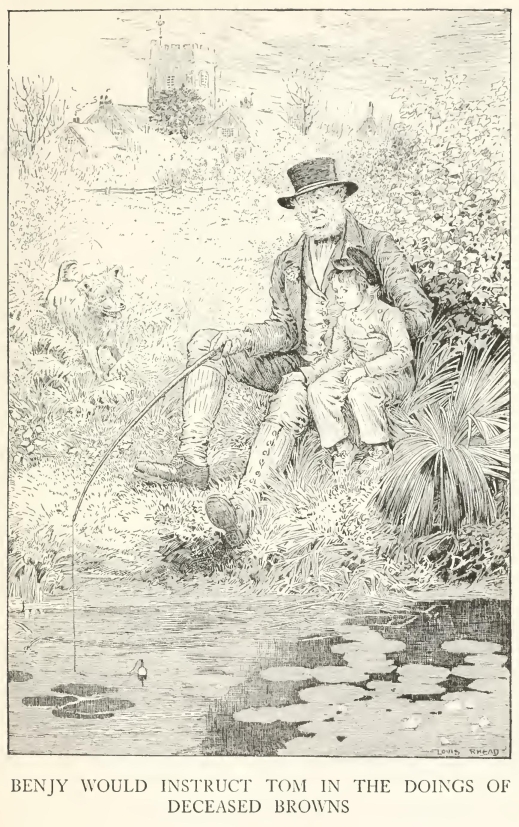
But old Benjy was young master's real delight and refuge. He was a youth by the side of Noah, scarce seventy years old—a cheery, humorous, kind-hearted old man, full of sixty years of Vale gossip, and of all sorts of helpful ways for young and old, but above all for children. It was he who bent the first pin with which Tom extracted his first stickleback out of “Pebbly Brook,” the little stream which ran through the village. The first stickleback was a splendid fellow, with fabulous red and blue gills. Tom kept him in a small basin till the day of his death, and became a fisherman from that day. Within a month from the taking of the first stickleback, Benjy had carried off our hero to the canal, in defiance of Charity; and between them, after a whole afternoon's popjoying, they had caught three or four small, coarse fish and a perch, averaging perhaps two and a half ounces each, which Tom bore home in rapture to his mother as a precious gift, and which she received like a true mother with equal rapture, instructing the cook nevertheless, in a private interview, not to prepare the same for the Squire's dinner. Charity had appealed against old Benjy in the meantime, representing the dangers of the canal banks; but Mrs. Brown, seeing the boy's inaptitude for female guidance, had decided in Benjy's favour, and from thenceforth the old man was Tom's dry nurse. And as they sat by the canal watching their little green-and-white float, Benjy would instruct him in the doings of deceased Browns. How his grandfather, in the early days of the great war, when there was much distress and crime in the Vale, and the magistrates had been threatened by the mob, had ridden in with a big stick in his hand, and held the petty sessions by himself. How his great-uncle, the rector, had encountered and laid the last ghost, who had frightened the old women, male and female, of the parish out of their senses, and who turned out to be the blacksmith's apprentice disguised in drink and a white sheet. It was Benjy, too, who saddled Tom's first pony, and instructed him in the mysteries of horsemanship, teaching him to throw his weight back and keep his hand low, and who stood chuckling outside the door of the girls' school when Tom rode his little Shetland into the cottage and round the table, where the old dame and her pupils were seated at their work.
Original
Benjy himself was come of a family distinguished in the Vale for their prowess in all athletic games. Some half-dozen of his brothers and kinsmen had gone to the wars, of whom only one had survived to come home, with a small pension, and three bullets in different parts of his body; he had shared Benjy's cottage till his death, and had left him his old dragoon's sword and pistol, which hung over the mantelpiece, flanked by a pair of heavy single-sticks with which Benjy himself had won renown long ago as an old gamester, against the picked men of Wiltshire and Somersetshire, in many a good bout at the revels and pastimes of the country-side. For he had been a famous back-swordman in his young days, and a good wrestler at elbow and collar.
Back-swording and wrestling were the most serious holiday pursuits of the Vale—those by which men attained fame—and each village had its champion. I suppose that, on the whole, people were less worked then than they are now; at any rate, they seemed to have more time and energy for the old pastimes. The great times for back-swording came round once a year in each village; at the feast. The Vale “veasts” were not the common statute feasts, but much more ancient business. They are literally, so far as one can ascertain, feasts of the dedication—that is, they were first established in the churchyard on the day on which the village church was opened for public worship, which was on the wake or festival of the patron saint, and have been held on the same day in every year since that time.
There was no longer any remembrance of why the “veast” had been instituted, but nevertheless it had a pleasant and almost sacred character of its own; for it was then that all the children of the village, wherever they were scattered, tried to get home for a holiday to visit their fathers and mothers and friends, bringing with them their wages or some little gift from up the country for the old folk. Perhaps for a day or two before, but at any rate on “veast day” and the day after, in our village, you might see strapping, healthy young men and women from all parts of the country going round from house to house in their best clothes, and finishing up with a call on Madam Brown, whom they would consult as to putting out their earnings to the best advantage, or how best to expend the same for the benefit of the old folk. Every household, however poor, managed to raise a “feast-cake” and a bottle of ginger or raisin wine, which stood on the cottage table ready for all comers, and not unlikely to make them remember feast-time, for feast-cake is very solid, and full of huge raisins. Moreover, feast-time was the day of reconciliation for the parish. If Job Higgins and Noah Freeman hadn't spoken for the last six months, their “old women” would be sure to get it patched up by that day. And though there was a good deal of drinking and low vice in the booths of an evening, it was pretty well confined to those who would have been doing the like, “veast or no veast;” and on the whole, the effect was humanising and Christian. In fact, the only reason why this is not the case still is that gentlefolk and farmers have taken to other amusements, and have, as usual, forgotten the poor. They don't attend the feasts themselves, and call them disreputable; whereupon the steadiest of the poor leave them also, and they become what they are called. Class amusements, be they for dukes or ploughboys, always become nuisances and curses to a country. The true charm of cricket and hunting is that they are still more or less sociable and universal; there's a place for every man who will come and take his part.
No one in the village enjoyed the approach of “veast day” more than Tom, in the year in which he was taken under old Benjy's tutelage. The feast was held in a large green field at the lower end of the village. The road to Farringdon ran along one side of it, and the brook by the side of the road; and above the brook was another large, gentle, sloping pasture-land, with a footpath running down it from the churchyard; and the old church, the originator of all the mirth, towered up with its gray walls and lancet windows, overlooking and sanctioning the whole, though its own share therein had been forgotten. At the point where the footpath crossed the brook and road, and entered on the field where the feast was held, was a long, low roadside inn; and on the opposite side of the field was a large white thatched farmhouse, where dwelt an old sporting farmer, a great promoter of the revels.
Past the old church, and down the footpath, pottered the old man and the child hand-in-hand early on the afternoon of the day before the feast, and wandered all round the ground, which was already being occupied by the “cheap Jacks,” with their green-covered carts and marvellous assortment of wares; and the booths of more legitimate small traders, with their tempting arrays of fairings and eatables; and penny peep-shows and other shows, containing pink-eyed ladies, and dwarfs, and boa-constrictors, and wild Indians. But the object of most interest to Benjy, and of course to his pupil also, was the stage of rough planks some four feet high, which was being put up by the village carpenter for the back-swording and wrestling. And after surveying the whole tenderly, old Benjy led his charge away to the roadside inn, where he ordered a glass of ale and a long pipe for himself, and discussed these unwonted luxuries on the bench outside in the soft autumn evening with mine host, another old servant of the Browns, and speculated with him on the likelihood of a good show of old gamesters to contend for the morrow's prizes, and told tales of the gallant bouts of forty years back, to which Tom listened with all his ears and eyes.
But who shall tell the joy of the next morning, when the church bells were ringing a merry peal, and old Benjy appeared in the servants' hall, resplendent in a long blue coat and brass buttons, and a pair of old yellow buckskins and top-boots which he had cleaned for and inherited from Tom's grandfather, a stout thorn stick in his hand, and a nosegay of pinks and lavender in his buttonhole, and led away Tom in his best clothes, and two new shillings in his breeches-pockets? Those two, at any rate, look like enjoying the day's revel.
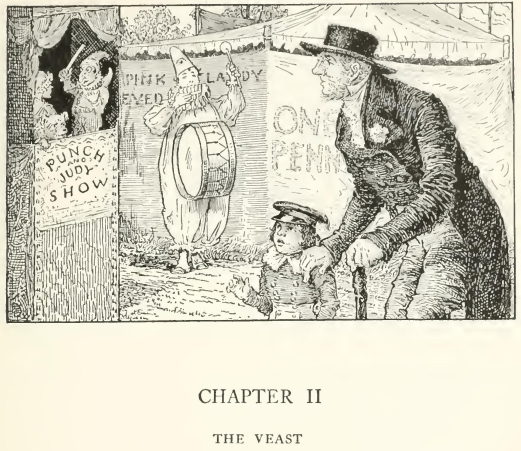
They quicken their pace when they get into the churchyard, for already they see the field thronged with country folk; the men in clean, white smocks or velveteen or fustian coats, with rough plush waistcoats of many colours, and the women in the beautiful, long scarlet cloak—the usual out-door dress of west-country women in those days, and which often descended in families from mother to daughter—or in new-fashioned stuff shawls, which, if they would but believe it, don't become them half so well. The air resounds with the pipe and tabor, and the drums and trumpets of the showmen shouting at the doors of their caravans, over which tremendous pictures of the wonders to be seen within hang temptingly; while through all rises the shrill “root-too-too-too” of Mr. Punch, and the unceasing pan-pipe of his satellite.
“Lawk a' massey, Mr. Benjamin,” cries a stout, motherly woman in a red cloak, as they enter the field, “be that you? Well, I never! You do look purely. And how's the Squire, and madam, and the family?”
Benjy graciously shakes hands with the speaker, who has left our village for some years, but has come over for “veast” day on a visit to an old gossip, and gently indicates the heir-apparent of the Browns.
“Bless his little heart! I must gi' un a kiss.—Here, Susannah, Susannah!” cries she, raising herself from the embrace, “come and see Mr. Benjamin and young Master Tom.—You minds our Sukey, Mr. Benjamin; she be growed a rare slip of a wench since you seen her, though her'll be sixteen come Martinmas. I do aim to take her to see madam to get her a place.”
And Sukey comes bouncing away from a knot of old school-fellows, and drops a curtsey to Mr. Benjamin. And elders come up from all parts to salute Benjy, and girls who have been madam's pupils to kiss Master Tom. And they carry him off to load him with fairings; and he returns to Benjy, his hat and coat covered with ribbons, and his pockets crammed with wonderful boxes which open upon ever new boxes, and popguns, and trumpets, and apples, and gilt gingerbread from the stall of Angel Heavens, sole vender thereof, whose booth groans with kings and queens, and elephants and prancing steeds, all gleaming with gold. There was more gold on Angel's cakes than there is ginger in those of this degenerate age. Skilled diggers might yet make a fortune in the churchyards of the Vale, by carefully washing the dust of the consumers of Angel's gingerbread. Alas! he is with his namesakes, and his receipts have, I fear, died with him.
And then they inspect the penny peep-show—at least Tom does—while old Benjy stands outside and gossips and walks up the steps, and enters the mysterious doors of the pink-eyed lady and the Irish giant, who do not by any means come up to their pictures; and the boa will not swallow his rabbit, but there the rabbit is waiting to be swallowed; and what can you expect for tuppence? We are easily pleased in the Vale. Now there is a rush of the crowd, and a tinkling bell is heard, and shouts of laughter; and Master Tom mounts on Benjy's shoulders, and beholds a jingling match in all its glory. The games are begun, and this is the opening of them. It is a quaint game, immensely amusing to look at; and as I don't know whether it is used in your counties, I had better describe it. A large roped ring is made, into which are introduced a dozen or so of big boys and young men who mean to play; these are carefully blinded and turned loose into the ring, and then a man is introduced not blindfolded; with a bell hung round his neck, and his two hands tied behind him. Of course every time he moves the bell must ring, as he has no hand to hold it; and so the dozen blindfolded men have to catch him. This they cannot always manage if he is a lively fellow, but half of them always rush into the arms of the other half, or drive their heads together, or tumble over; and then the crowd laughs vehemently, and invents nicknames for them on the spur of the moment; and they, if they be choleric, tear off the handkerchiefs which blind them, and not unfrequently pitch into one another, each thinking that the other must have run against him on purpose. It is great fun to look at a jingling match certainly, and Tom shouts and jumps on old Benjy's shoulders at the sight, until the old man feels weary, and shifts him to the strong young shoulders of the groom, who has just got down to the fun.
And now, while they are climbing the pole in another part of the field, and muzzling in a flour-tub in another, the old farmer whose house, as has been said, overlooks the field, and who is master of the revels, gets up the steps on to the stage, and announces to all whom it may concern that a half-sovereign in money will be forthcoming to the old gamester who breaks most heads; to which the Squire and he have added a new hat.
The amount of the prize is sufficient to stimulate the men of the immediate neighbourhood, but not enough to bring any very high talent from a distance; so, after a glance or two round, a tall fellow, who is a down shepherd, chucks his hat on to the stage and climbs up the steps, looking rather sheepish. The crowd, of course, first cheer, and then chaff as usual, as he picks up his hat and begins handling the sticks to see which will suit him.
“Wooy, Willum Smith, thee canst plaay wi' he arra daay,” says his companion to the blacksmith's apprentice, a stout young fellow of nineteen or twenty. Willum's sweetheart is in the “veast” somewhere, and has strictly enjoined him not to get his head broke at back-swording, on pain of her highest displeasure; but as she is not to be seen (the women pretend not to like to see the backsword play, and keep away from the stage), and as his hat is decidedly getting old, he chucks it on to the stage, and follows himself, hoping that he will only have to break other people's heads, or that, after all, Rachel won't really mind.
Then follows the greasy cap lined with fur of a half-gypsy, poaching, loafing fellow, who travels the Vale not for much good, I fancy:
“For twenty times was Peter feared For once that Peter was respected,”
in fact. And then three or four other hats, including the glossy castor of Joe Willis, the self-elected and would-be champion of the neighbourhood, a well-to-do young butcher of twenty-eight or thereabouts, and a great strapping fellow, with his full allowance of bluster. This is a capital show of gamesters, considering the amount of the prize; so, while they are picking their sticks and drawing their lots, I think I must tell you, as shortly as I can, how the noble old game of back-sword is played; for it is sadly gone out of late, even in the Vale, and maybe you have never seen it.
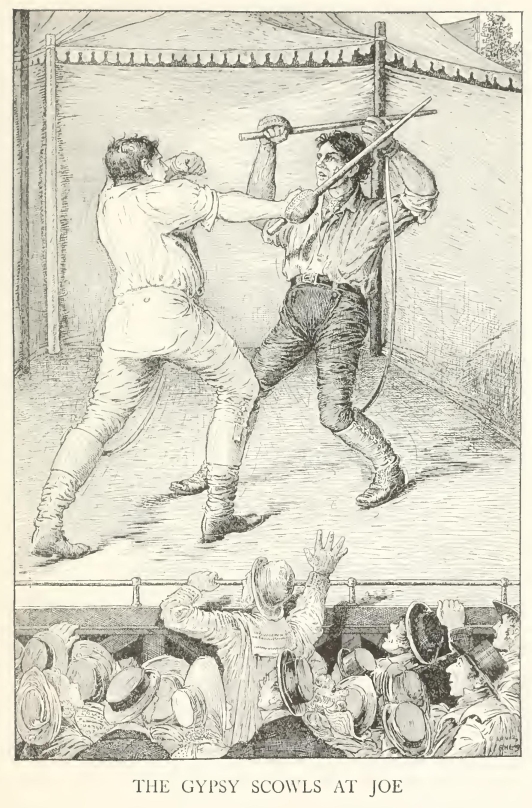
The weapon is a good stout ash stick with a large basket handle, heavier and somewhat shorter than a common single-stick. The players are called “old gamesters”—why, I can't tell you—and their object is simply to break one another's heads; for the moment that blood runs an inch anywhere above the eyebrow, the old gamester to whom it belongs is beaten, and has to stop. A very slight blow with the sticks will fetch blood, so that it is by no means a punishing pastime, if the men don't play on purpose and savagely at the body and arms of their adversaries. The old gamester going into action only takes off his hat and coat, and arms himself with a stick; he then loops the fingers of his left hand in a handkerchief or strap, which he fastens round his left leg, measuring the length, so that when he draws it tight with his left elbow in the air, that elbow shall just reach as high as his crown. Thus you see, so long as he chooses to keep his left elbow up, regardless of cuts, he has a perfect guard for the left side of his head. Then he advances his right hand above and in front of his head, holding his stick across, so that its point projects an inch or two over his left elbow; and thus his whole head is completely guarded, and he faces his man armed in like manner; and they stand some three feet apart, often nearer, and feint, and strike, and return at one another's heads, until one cries “hold,” or blood flows. In the first case they are allowed a minute's time; and go on again; in the latter another pair of gamesters are called on. If good men are playing, the quickness of the returns is marvellous: you hear the rattle like that a boy makes drawing his stick along palings, only heavier; and the closeness of the men in action to one another gives it a strange interest, and makes a spell at back-swording a very noble sight.
They are all suited now with sticks, and Joe Willis and the gypsy man have drawn the first lot. So the rest lean against the rails of the stage, and Joe and the dark man meet in the middle, the boards having been strewed with sawdust, Joe's white shirt and spotless drab breeches and boots contrasting with the gypsy's coarse blue shirt and dirty green velveteen breeches and leather gaiters. Joe is evidently turning up his nose at the other, and half insulted at having to break his head.
The gypsy is a tough, active fellow, but not very skilful with his weapon, so that Joe's weight and strength tell in a minute; he is too heavy metal for him. Whack, whack, whack, come his blows, breaking down the gypsy's guard, and threatening to reach his head every moment. There it is at last. “Blood, blood!” shout the spectators, as a thin stream oozes out slowly from the roots of his hair, and the umpire calls to them to stop. The gypsy scowls at Joe under his brows in no pleasant manner, while Master Joe swaggers about, and makes attitudes, and thinks himself, and shows that he thinks himself, the greatest man in the field.
Original
Then follow several stout sets-to between the other candidates for the new hat, and at last come the shepherd and Willum Smith. This is the crack set-to of the day. They are both in famous wind, and there is no crying “hold.” The shepherd is an old hand, and up to all the dodges. He tries them one after another, and very nearly gets at Willum's head by coming in near, and playing over his guard at the half-stick; but somehow Willum blunders through, catching the stick on his shoulders, neck, sides, every now and then, anywhere but on his head, and his returns are heavy and straight, and he is the youngest gamester and a favourite in the parish, and his gallant stand brings down shouts and cheers, and the knowing ones think he'll win if he keeps steady; and Tom, on the groom's shoulder, holds his hands together, and can hardly breathe for excitement.
Alas for Willum! His sweetheart, getting tired of female companionship, has been hunting the booths to see where he can have got to, and now catches sight of him on the stage in full combat. She flushes and turns pale; her old aunt catches hold of her, saying, “Bless 'ee, child, doan't 'ee go a'nigst it;” but she breaks away and runs towards the stage calling his name. Willum keeps up his guard stoutly, but glances for a moment towards the voice. No guard will do it, Willum, without the eye. The shepherd steps round and strikes, and the point of his stick just grazes Willum's forehead, fetching off the skin, and the blood flows, and the umpire cries, “Hold!” and poor Willum's chance is up for the day. But he takes it very well, and puts on his old hat and coat, and goes down to be scolded by his sweetheart, and led away out of mischief. Tom hears him say coaxingly, as he walks off,—
“Now doan't 'ee, Rachel! I wouldn't ha' done it, only I wanted summut to buy 'ee a fairing wi', and I be as vlush o' money as a twod o' feathers.”
“Thee mind what I tells 'ee,” rejoins Rachel saucily, “and doan't 'ee kep blethering about fairings.”
Tom resolves in his heart to give Willum the remainder of his two shillings after the back-swording.
Joe Willis has all the luck to-day. His next bout ends in an easy victory, while the shepherd has a tough job to break his second head; and when Joe and the shepherd meet, and the whole circle expect and hope to see him get a broken crown, the shepherd slips in the first round and falls against the rails, hurting himself so that the old farmer will not let him go on, much as he wishes to try; and that impostor Joe (for he is certainly not the best man) struts and swaggers about the stage the conquering gamester, though he hasn't had five minutes' really trying play.
Joe takes the new hat in his hand, and puts the money into it, and then, as if a thought strikes him, and he doesn't think his victory quite acknowledged down below, walks to each face of the stage, and looks down, shaking the money, and chaffing, as how he'll stake hat and money and another half-sovereign “agin any gamester as hasn't played already.” Cunning Joe! he thus gets rid of Willum and the shepherd, who is quite fresh again.
No one seems to like the offer, and the umpire is just coming down, when a queer old hat, something like a doctor of divinity's shovel, is chucked on to the stage and an elderly, quiet man steps out, who has been watching the play, saying he should like to cross a stick wi' the prodigalish young chap.
The crowd cheer, and begin to chaff Joe, who turns up his nose and swaggers across to the sticks. “Imp'dent old wosbird!” says he; “I'll break the bald head on un to the truth.”
The old boy is very bald, certainly, and the blood will show fast enough if you can touch him, Joe.
He takes off his long-flapped coat, and stands up in a long-flapped waistcoat, which Sir Roger de Coverley might have worn when it was new, picks out a stick, and is ready for Master Joe, who loses no time, but begins his old game, whack, whack, whack, trying to break down the old man's guard by sheer strength. But it won't do; he catches every blow close by the basket, and though he is rather stiff in his returns, after a minute walks Joe about the stage, and is clearly a stanch old gamester. Joe now comes in, and making the most of his height, tries to get over the old man's guard at half-stick, by which he takes a smart blow in the ribs and another on the elbow, and nothing more. And now he loses wind and begins to puff, and the crowd laugh. “Cry 'hold,' Joe; thee'st met thy match!” Instead of taking good advice and getting his wind, Joe loses his temper, and strikes at the old man's body.
“Blood, blood!” shout the crowd; “Joe's head's broke!”
Who'd have thought it? How did it come? That body-blow left Joe's head unguarded for a moment; and with one turn of the wrist the old gentleman has picked a neat little bit of skin off the middle of his forehead; and though he won't believe it, and hammers on for three more blows despite of the shouts, is then convinced by the blood trickling into his eye. Poor Joe is sadly crestfallen, and fumbles in his pocket for the other half-sovereign, but the old gamester won't have it. “Keep thy money, man, and gi's thy hand,” says he; and they shake hands. But the old gamester gives the new hat to the shepherd, and, soon after, the half-sovereign to Willum, who thereout decorates his sweetheart with ribbons to his heart's content.
“Who can a be?” “Wur do a cum from?” ask the crowd. And it soon flies about that the old west-country champion, who played a tie with Shaw the Lifeguardsman at “Vizes” twenty years before, has broken Joe Willis's crown for him.
How my country fair is spinning out! I see I must skip the wrestling; and the boys jumping in sacks, and rolling wheelbarrows blindfolded; and the donkey-race, and the fight which arose thereout, marring the otherwise peaceful “veast;” and the frightened scurrying away of the female feast-goers, and descent of Squire Brown, summoned by the wife of one of the combatants to stop it; which he wouldn't start to do till he had got on his top-boots. Tom is carried away by old Benjy, dog-tired and surfeited with pleasure, as the evening comes on and the dancing begins in the booths; and though Willum, and Rachel in her new ribbons, and many another good lad and lass don't come away just yet, but have a good step out, and enjoy it, and get no harm thereby, yet we, being sober folk, will just stroll away up through the churchyard, and by the old yew-tree, and get a quiet dish of tea and a parley with our gossips, as the steady ones of our village do, and so to bed.
That's the fair, true sketch, as far as it goes, of one of the larger village feasts in the Vale of Berks, when I was a little boy. They are much altered for the worse, I am told. I haven't been at one these twenty years, but I have been at the statute fairs in some west-country towns, where servants are hired, and greater abominations cannot be found. What village feasts have come to, I fear, in many cases, may be read in the pages of “Yeast” (though I never saw one so bad—thank God!).
Do you want to know why? It is because, as I said before, gentlefolk and farmers have left off joining or taking an interest in them. They don't either subscribe to the prizes, or go down and enjoy the fun.
Is this a good or a bad sign? I hardly know. Bad, sure enough, if it only arises from the further separation of classes consequent on twenty years of buying cheap and selling dear, and its accompanying overwork; or because our sons and daughters have their hearts in London club-life, or so-called “society,” instead of in the old English home-duties; because farmers' sons are apeing fine gentlemen, and farmers' daughters caring more to make bad foreign music than good English cheeses. Good, perhaps, if it be that the time for the old “veast” has gone by; that it is no longer the healthy, sound expression of English country holiday-making; that, in fact, we, as a nation, have got beyond it, and are in a transition state, feeling for and soon likely to find some better substitute.
Only I have just got this to say before I quit the text. Don't let reformers of any sort think that they are going really to lay hold of the working boys and young men of England by any educational grapnel whatever, which isn't some bona fide equivalent for the games of the old country “veast” in it; something to put in the place of the back-swording and wrestling and racing; something to try the muscles of men's bodies, and the endurance of their hearts, and to make them rejoice in their strength. In all the new-fangled comprehensive plans which I see, this is all left out; and the consequence is, that your great mechanics' institutes end in intellectual priggism, and your Christian young men's societies in religious Pharisaism.
Well, well, we must bide our time. Life isn't all beer and skittles; but beer and skittles, or something better of the same sort, must form a good part of every Englishman's education. If I could only drive this into the heads of you rising parliamentary lords, and young swells who “have your ways made for you,” as the saying is, you, who frequent palaver houses and West-end clubs, waiting always ready to strap yourselves on to the back of poor dear old John, as soon as the present used-up lot (your fathers and uncles), who sit there on the great parliamentary-majorities' pack-saddle, and make believe they're guiding him with their red-tape bridle, tumble, or have to be lifted off!
I don't think much of you yet—I wish I could—though you do go talking and lecturing up and down the country to crowded audiences, and are busy with all sorts of philanthropic intellectualism, and circulating libraries and museums, and Heaven only knows what besides, and try to make us think, through newspaper reports, that you are, even as we, of the working classes. But bless your hearts, we “ain't so green,” though lots of us of all sorts toady you enough certainly, and try to make you think so.
I'll tell you what to do now: instead of all this trumpeting and fuss, which is only the old parliamentary-majority dodge over again, just you go, each of you (you've plenty of time for it, if you'll only give up t'other line), and quietly make three or four friends—real friends—among us. You'll find a little trouble in getting at the right sort, because such birds don't come lightly to your lure; but found they may be. Take, say, two out of the professions, lawyer, parson, doctor—which you will; one out of trade; and three or four out of the working classes—tailors, engineers, carpenters, engravers. There's plenty of choice. Let them be men of your own ages, mind, and ask them to your homes; introduce them to your wives and sisters, and get introduced to theirs; give them good dinners, and talk to them about what is really at the bottom of your hearts; and box, and run, and row with them, when you have a chance. Do all this honestly as man to man, and by the time you come to ride old John, you'll be able to do something more than sit on his back, and may feel his mouth with some stronger bridle than a red-tape one.
Ah, if you only would! But you have got too far out of the right rut, I fear. Too much over-civilization, and the deceitfulness of riches. It is easier for a camel to go through the eye of a needle. More's the pity. I never came across but two of you who could value a man wholly and solely for what was in him—who thought themselves verily and indeed of the same flesh and blood as John Jones the attorney's clerk, and Bill Smith the costermonger, and could act as if they thought so.
Original
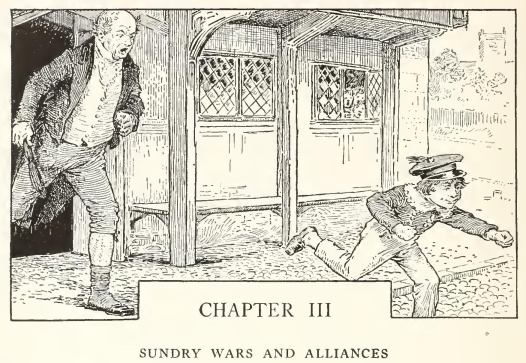
CHAPTER III—SUNDRY WARS AND ALLIANCES.
 Original
oor old Benjy! The “rheumatiz” has much to answer for all through English country-sides, but it never played a scurvier trick than in laying thee by the heels, when thou wast yet in a green old age. The enemy, which had long been carrying on a sort of border warfare, and trying his strength against Benjy's on the battlefield of his hands and legs, now, mustering all his forces, began laying siege to the citadel, and overrunning the whole country. Benjy was seized in the back and loins; and though he made strong and brave fight, it was soon clear enough that all which could be beaten of poor old Benjy would have to give in before long.
It was as much as he could do now, with the help of his big stick and frequent stops, to hobble down to the canal with Master Tom, and bait his hook for him, and sit and watch his angling, telling him quaint old country stories; and when Tom had no sport, and detecting a rat some hundred yards or so off along the bank, would rush off with Toby the turnspit terrier, his other faithful companion, in bootless pursuit, he might have tumbled in and been drowned twenty times over before Benjy could have got near him.
Cheery and unmindful of himself, as Benjy was, this loss of locomotive power bothered him greatly. He had got a new object in his old age, and was just beginning to think himself useful again in the world. He feared much, too, lest Master Tom should fall back again into the hands of Charity and the women. So he tried everything he could think of to get set up. He even went an expedition to the dwelling of one of those queer mortals, who—say what we will, and reason how we will—do cure simple people of diseases of one kind or another without the aid of physic, and so get to themselves the reputation of using charms, and inspire for themselves and their dwellings great respect, not to say fear, amongst a simple folk such as the dwellers in the Vale of White Horse. Where this power, or whatever else it may be, descends upon the shoulders of a man whose ways are not straight, he becomes a nuisance to the neighbourhood—a receiver of stolen goods, giver of love-potions, and deceiver of silly women—the avowed enemy of law and order, of justices of the peace, head-boroughs, and gamekeepers,—such a man, in fact, as was recently caught tripping, and deservedly dealt with by the Leeds justices, for seducing a girl who had come to him to get back a faithless lover, and has been convicted of bigamy since then. Sometimes, however, they are of quite a different stamp—men who pretend to nothing, and are with difficulty persuaded to exercise their occult arts in the simplest cases.
Of this latter sort was old Farmer Ives, as he was called, the “wise man” to whom Benjy resorted (taking Tom with him as usual), in the early spring of the year next after the feast described in the last chapter. Why he was called “farmer” I cannot say, unless it be that he was the owner of a cow, a pig or two, and some poultry, which he maintained on about an acre of land inclosed from the middle of a wild common, on which probably his father had squatted before lords of manors looked as keenly after their rights as they do now. Here he had lived no one knew how long, a solitary man. It was often rumoured that he was to be turned out and his cottage pulled down, but somehow it never came to pass; and his pigs and cow went grazing on the common, and his geese hissed at the passing children and at the heels of the horse of my lord's steward, who often rode by with a covetous eye on the inclosure still unmolested. His dwelling was some miles from our village; so Benjy, who was half ashamed of his errand, and wholly unable to walk there, had to exercise much ingenuity to get the means of transporting himself and Tom thither without exciting suspicion. However, one fine May morning he managed to borrow the old blind pony of our friend the publican, and Tom persuaded Madam Brown to give him a holiday to spend with old Benjy, and to lend them the Squire's light cart, stored with bread and cold meat and a bottle of ale. And so the two in high glee started behind old Dobbin, and jogged along the deep-rutted plashy roads, which had not been mended after their winter's wear, towards the dwelling of the wizard. About noon they passed the gate which opened on to the large common, and old Dobbin toiled slowly up the hill, while Benjy pointed out a little deep dingle on the left, out of which welled a tiny stream. As they crept up the hill the tops of a few birch-trees came in sight, and blue smoke curling up through their delicate light boughs; and then the little white thatched home and inclosed ground of Farmer Ives, lying cradled in the dingle, with the gay gorse common rising behind and on both sides; while in front, after traversing a gentle slope, the eye might travel for miles and miles over the rich vale. They now left the main road and struck into a green track over the common marked lightly with wheel and horse-shoe, which led down into the dingle and stopped at the rough gate of Farmer Ives. Here they found the farmer, an iron-gray old man, with a bushy eyebrow and strong aquiline nose, busied in one of his vocations. He was a horse and cow doctor, and was tending a sick beast which had been sent up to be cured. Benjy hailed him as an old friend, and he returned the greeting cordially enough, looking however hard for a moment both at Benjy and Tom, to see whether there was more in their visit than appeared at first sight. It was a work of some difficulty and danger for Benjy to reach the ground, which, however, he managed to do without mishap; and then he devoted himself to unharnessing Dobbin and turning him out for a graze (“a run” one could not say of that virtuous steed) on the common. This done, he extricated the cold provisions from the cart, and they entered the farmer's wicket; and he, shutting up the knife with which he was taking maggots out of the cow's back and sides, accompanied them towards the cottage. A big old lurcher got up slowly from the door-stone, stretching first one hind leg and then the other, and taking Tom's caresses and the presence of Toby, who kept, however, at a respectful distance, with equal indifference.
“Us be cum to pay 'ee a visit. I've a been long minded to do't for old sake's sake, only I vinds I dwon't get about now as I'd used to't. I be so plaguy bad wi' th' rheumatiz in my back.” Benjy paused, in hopes of drawing the farmer at once on the subject of his ailments without further direct application.
“Ah, I see as you bean't quite so lissom as you was,” replied the farmer, with a grim smile, as he lifted the latch of his door; “we bean't so young as we was, nother on us, wuss luck.”
The farmer's cottage was very like those of the better class of peasantry in general. A snug chimney corner with two seats, and a small carpet on the hearth, an old flint gun and a pair of spurs over the fireplace, a dresser with shelves on which some bright pewter plates and crockeryware were arranged, an old walnut table, a few chairs and settles, some framed samplers, and an old print or two, and a bookcase with some dozen volumes on the walls, a rack with flitches of bacon, and other stores fastened to the ceiling, and you have the best part of the furniture. No sign of occult art is to be seen, unless the bundles of dried herbs hanging to the rack and in the ingle and the row of labelled phials on one of the shelves betoken it.
Tom played about with some kittens who occupied the hearth, and with a goat who walked demurely in at the open door—while their host and Benjy spread the table for dinner—and was soon engaged in conflict with the cold meat, to which he did much honour. The two old men's talk was of old comrades and their deeds, mute inglorious Miltons of the Vale, and of the doings thirty years back, which didn't interest him much, except when they spoke of the making of the canal; and then indeed he began to listen with all his ears, and learned, to his no small wonder, that his dear and wonderful canal had not been there always—was not, in fact, so old as Benjy or Farmer Ives, which caused a strange commotion in his small brain.
After dinner Benjy called attention to a wart which Tom had on the knuckles of his hand, and which the family doctor had been trying his skill on without success, and begged the farmer to charm it away. Farmer Ives looked at it, muttered something or another over it, and cut some notches in a short stick, which he handed to Benjy, giving him instructions for cutting it down on certain days, and cautioning Tom not to meddle with the wart for a fortnight. And then they strolled out and sat on a bench in the sun with their pipes, and the pigs came up and grunted sociably and let Tom scratch them; and the farmer, seeing how he liked animals, stood up and held his arms in the air, and gave a call, which brought a flock of pigeons wheeling and dashing through the birch-trees. They settled down in clusters on the farmer's arms and shoulders, making love to him and scrambling over one another's backs to get to his face; and then he threw them all off, and they fluttered about close by, and lighted on him again and again when he held up his arms. All the creatures about the place were clean and fearless, quite unlike their relations elsewhere; and Tom begged to be taught how to make all the pigs and cows and poultry in our village tame, at which the farmer only gave one of his grim chuckles.
It wasn't till they were just ready to go, and old Dobbin was harnessed, that Benjy broached the subject of his rheumatism again, detailing his symptoms one by one. Poor old boy! He hoped the farmer could charm it away as easily as he could Tom's wart, and was ready with equal faith to put another notched stick into his other pocket, for the cure of his own ailments. The physician shook his head, but nevertheless produced a bottle, and handed it to Benjy, with instructions for use. “Not as 't'll do 'ee much good—leastways I be afeard not,” shading his eyes with his hand, and looking up at them in the cart. “There's only one thing as I knows on as'll cure old folks like you and I o' th' rheumatiz.”
“Wot be that then, farmer?” inquired Benjy.
“Churchyard mould,” said the old iron-gray man, with another chuckle. And so they said their good-byes and went their ways home. Tom's wart was gone in a fortnight, but not so Benjy's rheumatism, which laid him by the heels more and more. And though Tom still spent many an hour with him, as he sat on a bench in the sunshine, or by the chimney corner when it was cold, he soon had to seek elsewhere for his regular companions.
Tom had been accustomed often to accompany his mother in her visits to the cottages, and had thereby made acquaintance with many of the village boys of his own age. There was Job Rudkin, son of widow Rudkin, the most bustling woman in the parish. How she could ever have had such a stolid boy as Job for a child must always remain a mystery. The first time Tom went to their cottage with his mother, Job was not indoors; but he entered soon after, and stood with both hands in his pockets, staring at Tom. Widow Rudkin, who would have had to cross madam to get at young Hopeful—a breach of good manners of which she was wholly incapable—began a series of pantomime signs, which only puzzled him; and at last, unable to contain herself longer, burst out with, “Job! Job! where's thy cap?”
“What! bean't 'ee on ma head, mother?” replied Job, slowly extricating one hand from a pocket, and feeling for the article in question; which he found on his head sure enough, and left there, to his mother's horror and Tom's great delight.
Then there was poor Jacob Dodson, the half-witted boy, who ambled about cheerfully, undertaking messages and little helpful odds and ends for every one, which, however, poor Jacob managed always hopelessly to imbrangle. Everything came to pieces in his hands, and nothing would stop in his head. They nicknamed him Jacob Doodle-calf.
But above all there was Harry Winburn, the quickest and best boy in the parish. He might be a year older than Tom, but was very little bigger, and he was the Crichton of our village boys. He could wrestle and climb and run better than all the rest, and learned all that the schoolmaster could teach him faster than that worthy at all liked. He was a boy to be proud of, with his curly brown hair, keen gray eye, straight active figure, and little ears and hands and feet, “as fine as a lord's,” as Charity remarked to Tom one day, talking, as usual, great nonsense. Lords' hands and ears and feet are just as ugly as other folk's when they are children, as any one may convince himself if he likes to look. Tight boots and gloves, and doing nothing with them, I allow make a difference by the time they are twenty.
Now that Benjy was laid on the shelf, and his young brothers were still under petticoat government, Tom, in search of companions, began to cultivate the village boys generally more and more. Squire Brown, be it said, was a true-blue Tory to the backbone, and believed honestly that the powers which be were ordained of God, and that loyalty and steadfast obedience were men's first duties. Whether it were in consequence or in spite of his political creed, I do not mean to give an opinion, though I have one; but certain it is that he held therewith divers social principles not generally supposed to be true blue in colour. Foremost of these, and the one which the Squire loved to propound above all others, was the belief that a man is to be valued wholly and solely for that which he is in himself, for that which stands up in the four fleshly walls of him, apart from clothes, rank, fortune, and all externals whatsoever. Which belief I take to be a wholesome corrective of all political opinions, and, if held sincerely, to make all opinions equally harmless, whether they be blue, red, or green. As a necessary corollary to this belief, Squire Brown held further that it didn't matter a straw whether his son associated with lords' sons or ploughmen's sons, provided they were brave and honest. He himself had played football and gone bird-nesting with the farmers whom he met at vestry and the labourers who tilled their fields, and so had his father and grandfather, with their progenitors. So he encouraged Tom in his intimacy with the boys of the village, and forwarded it by all means in his power, and gave them the run of a close for a playground, and provided bats and balls and a football for their sports.
Our village was blessed amongst other things with a well-endowed school. The building stood by itself, apart from the master's house, on an angle of ground where three roads met—an old gray stone building with a steep roof and mullioned windows. On one of the opposite angles stood Squire Brown's stables and kennel, with their backs to the road, over which towered a great elm-tree; on the third stood the village carpenter and wheelwright's large open shop, and his house and the schoolmaster's, with long low eaves, under which the swallows built by scores.
The moment Tom's lessons were over, he would now get him down to this corner by the stables, and watch till the boys came out of school. He prevailed on the groom to cut notches for him in the bark of the elm so that he could climb into the lower branches; and there he would sit watching the school door, and speculating on the possibility of turning the elm into a dwelling-place for himself and friends, after the manner of the Swiss Family Robinson. But the school hours were long and Tom's patience short, so that he soon began to descend into the street, and go and peep in at the school door and the wheelwright's shop, and look out for something to while away the time. Now the wheelwright was a choleric man, and one fine afternoon, returning from a short absence, found Tom occupied with one of his pet adzes, the edge of which was fast vanishing under our hero's care. A speedy flight saved Tom from all but one sound cuff on the ears; but he resented this unjustifiable interruption of his first essays at carpentering, and still more the further proceedings of the wheelwright, who cut a switch, and hung it over the door of his workshop, threatening to use it upon Tom if he came within twenty yards of his gate. So Tom, to retaliate, commenced a war upon the swallows who dwelt under the wheelwright's eaves, whom he harassed with sticks and stones; and being fleeter of foot than his enemy, escaped all punishment, and kept him in perpetual anger. Moreover, his presence about the school door began to incense the master, as the boys in that neighbourhood neglected their lessons in consequence; and more than once he issued into the porch, rod in hand, just as Tom beat a hasty retreat. And he and the wheelwright, laying their heads together, resolved to acquaint the Squire with Tom's afternoon occupations; but in order to do it with effect, determined to take him captive and lead him away to judgment fresh from his evil doings. This they would have found some difficulty in doing, had Tom continued the war single-handed, or rather single-footed, for he would have taken to the deepest part of Pebbly Brook to escape them; but, like other active powers, he was ruined by his alliances. Poor Jacob Doodle-calf could not go to the school with the other boys, and one fine afternoon, about three o'clock (the school broke up at four), Tom found him ambling about the street, and pressed him into a visit to the school-porch. Jacob, always ready to do what he was asked, consented, and the two stole down to the school together. Tom first reconnoitred the wheelwright's shop; and seeing no signs of activity, thought all safe in that quarter, and ordered at once an advance of all his troops upon the schoolporch. The door of the school was ajar, and the boys seated on the nearest bench at once recognized and opened a correspondence with the invaders. Tom, waxing bold, kept putting his head into the school and making faces at the master when his back was turned. Poor Jacob, not in the least comprehending the situation, and in high glee at finding himself so near the school, which he had never been allowed to enter, suddenly, in a fit of enthusiasm, pushed by Tom, and ambling three steps into the school, stood there, looking round him and nodding with a self-approving smile. The master, who was stooping over a boy's slate, with his back to the door, became aware of something unusual, and turned quickly round. Tom rushed at Jacob, and began dragging him back by his smock-frock, and the master made at them, scattering forms and boys in his career. Even now they might have escaped, but that in the porch, barring retreat, appeared the crafty wheelwright, who had been watching all their proceedings. So they were seized, the school dismissed, and Tom and Jacob led away to Squire Brown as lawful prize, the boys following to the gate in groups, and speculating on the result.
The Squire was very angry at first, but the interview, by Tom's pleading, ended in a compromise. Tom was not to go near the school till three o'clock, and only then if he had done his own lessons well, in which case he was to be the bearer of a note to the master from Squire Brown; and the master agreed in such case to release ten or twelve of the best boys an hour before the time of breaking up, to go off and play in the close. The wheelwright's adzes and swallows were to be for ever respected; and that hero and the master withdrew to the servants' hall to drink the Squire's health, well satisfied with their day's work.
The second act of Tom's life may now be said to have begun. The war of independence had been over for some time: none of the women now—not even his mother's maid—dared offer to help him in dressing or washing. Between ourselves, he had often at first to run to Benjy in an unfinished state of toilet. Charity and the rest of them seemed to take a delight in putting impossible buttons and ties in the middle of his back; but he would have gone without nether integuments altogether, sooner than have had recourse to female valeting. He had a room to himself, and his father gave him sixpence a week pocket-money. All this he had achieved by Benjy's advice and assistance. But now he had conquered another step in life—the step which all real boys so long to make: he had got amongst his equals in age and strength, and could measure himself with other boys; he lived with those whose pursuits and wishes and ways were the same in kind as his own.
The little governess who had lately been installed in the house found her work grow wondrously easy, for Tom slaved at his lessons, in order to make sure of his note to the schoolmaster. So there were very few days in the week in which Tom and the village boys were not playing in their close by three o'clock. Prisoner's base, rounders, high-cock-a-lorum, cricket, football—he was soon initiated into the delights of them all; and though most of the boys were older than himself, he managed to hold his own very well. He was naturally active and strong, and quick of eye and hand, and had the advantage of light shoes and well-fitting dress, so that in a short time he could run and jump and climb with any of them.
They generally finished their regular games half an hour or so before tea-time, and then began trials of skill and strength in many ways. Some of them would catch the Shetland pony who was turned out in the field, and get two or three together on his back, and the little rogue, enjoying the fun, would gallop off for fifty yards, and then turn round, or stop short and shoot them on to the turf, and then graze quietly on till he felt another load; others played at peg-top or marbles, while a few of the bigger ones stood up for a bout at wrestling. Tom at first only looked on at this pastime, but it had peculiar attractions for him, and he could not long keep out of it. Elbow and collar wrestling, as practised in the western counties, was, next to back-swording, the way to fame for the youth of the Vale; and all the boys knew the rules of it, and were more or less expert. But Job Rudkin and Harry Winburn were the stars—the former stiff and sturdy, with legs like small towers; the latter pliant as indiarubber and quick as lightning. Day after day they stood foot to foot, and offered first one hand and then the other, and grappled and closed, and swayed and strained, till a well-aimed crook of the heel or thrust of the loin took effect, and a fair back-fall ended the matter. And Tom watched with all his eyes, and first challenged one of the less scientific, and threw him; and so one by one wrestled his way up to the leaders.
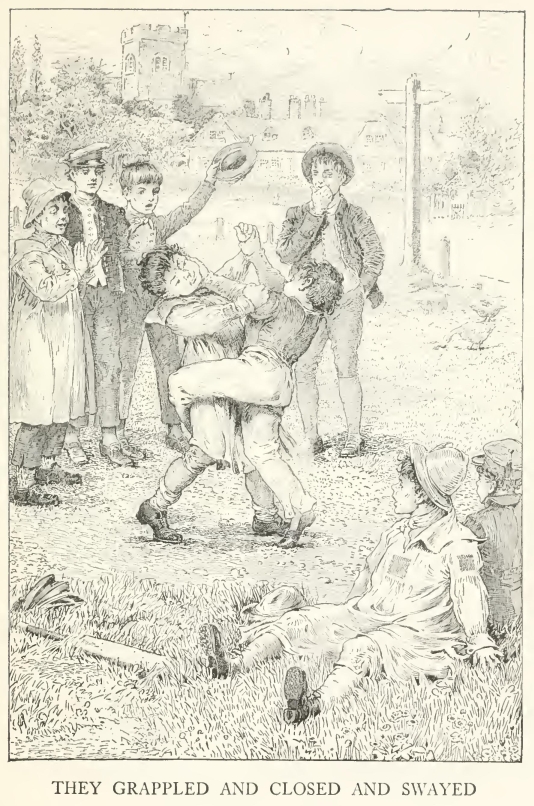
Original
Then indeed for months he had a poor time of it; it was not long indeed before he could manage to keep his legs against Job, for that hero was slow of offence, and gained his victories chiefly by allowing others to throw themselves against his immovable legs and loins. But Harry Winburn was undeniably his master; from the first clutch of hands when they stood up, down to the last trip which sent him on to his back on the turf, he felt that Harry knew more and could do more than he. Luckily Harry's bright unconsciousness and Tom's natural good temper kept them from quarrelling; and so Tom worked on and on, and trod more and more nearly on Harry's heels, and at last mastered all the dodges and falls except one. This one was Harry's own particular invention and pet; he scarcely ever used it except when hard pressed, but then out it came, and as sure as it did, over went poor Tom. He thought about that fall at his meals, in his walks, when he lay awake in bed, in his dreams, but all to no purpose, until Harry one day in his open way suggested to him how he thought it should be met; and in a week from that time the boys were equal, save only the slight difference of strength in Harry's favour, which some extra ten months of age gave. Tom had often afterwards reason to be thankful for that early drilling, and above all, for having mastered Harry Winburn's fall.
Besides their home games, on Saturdays the boys would wander all over the neighbourhood; sometimes to the downs, or up to the camp, where they cut their initials out in the springy turf, and watched the hawks soaring, and the “peert” bird, as Harry Winburn called the gray plover, gorgeous in his wedding feathers; and so home, racing down the Manger with many a roll among the thistles, or through Uffington Wood to watch the fox cubs playing in the green rides; sometimes to Rosy Brook, to cut long whispering reeds which grew there, to make pan-pipes of; sometimes to Moor Mills, where was a piece of old forest land, with short browsed turf and tufted brambly thickets stretching under the oaks, amongst which rumour declared that a raven, last of his race, still lingered; or to the sand-hills, in vain quest of rabbits; and bird-nesting in the season, anywhere and everywhere.
The few neighbours of the Squire's own rank every now and then would shrug their shoulders as they drove or rode by a party of boys with Tom in the middle, carrying along bulrushes or whispering reeds, or great bundles of cowslip and meadow-sweet, or young starlings or magpies, or other spoil of wood, brook, or meadow; and Lawyer Red-tape might mutter to Squire Straight-back at the Board that no good would come of the young Browns, if they were let run wild with all the dirty village boys, whom the best farmers' sons even would not play with. And the squire might reply with a shake of his head that his sons only mixed with their equals, and never went into the village without the governess or a footman. But, luckily, Squire Brown was full as stiffbacked as his neighbours, and so went on his own way; and Tom and his younger brothers, as they grew up, went on playing with the village boys, without the idea of equality or inequality (except in wrestling, running, and climbing) ever entering their heads; as it doesn't till it's put there by Jack Nastys or fine ladies' maids.
I don't mean to say it would be the case in all villages, but it certainly was so in this one: the village boys were full as manly and honest, and certainly purer, than those in a higher rank; and Tom got more harm from his equals in his first fortnight at a private school, where he went when he was nine years old, than he had from his village friends from the day he left Charity's apron-strings.
Great was the grief amongst the village school-boys when Tom drove off with the Squire, one August morning, to meet the coach on his way to school. Each of them had given him some little present of the best that he had, and his small private box was full of peg-taps, white marbles (called “alley-taws” in the Vale), screws, birds' eggs, whip-cord, jews-harps, and other miscellaneous boys' wealth. Poor Jacob Doodle-calf, in floods of tears, had pressed upon him with spluttering earnestness his lame pet hedgehog (he had always some poor broken-down beast or bird by him); but this Tom had been obliged to refuse, by the Squire's order. He had given them all a great tea under the big elm in their playground, for which Madam Brown had supplied the biggest cake ever seen in our village; and Tom was really as sorry to leave them as they to lose him, but his sorrow was not unmixed with the pride and excitement of making a new step in life.
And this feeling carried him through his first parting with his mother better than could have been expected. Their love was as fair and whole as human love can be—perfect self-sacrifice on the one side meeting a young and true heart on the other. It is not within the scope of my book, however, to speak of family relations, or I should have much to say on the subject of English mothers—ay, and of English fathers, and sisters, and brothers too. Neither have I room to speak of our private schools. What I have to say is about public schools—those much-abused and much-belauded institutions peculiar to England. So we must hurry through Master Tom's year at a private school as fast as we can.
It was a fair average specimen, kept by a gentleman, with another gentleman as second master; but it was little enough of the real work they did—merely coming into school when lessons were prepared and all ready to be heard. The whole discipline of the school out of lesson hours was in the hands of the two ushers, one of whom was always with the boys in their playground, in the school, at meals—in fact, at all times and every where, till they were fairly in bed at night.
Now the theory of private schools is (or was) constant supervision out of school—therein differing fundamentally from that of public schools.
It may be right or wrong; but if right, this supervision surely ought to be the especial work of the head-master, the responsible person. The object of all schools is not to ram Latin and Greek into boys, but to make them good English boys, good future citizens; and by far the most important part of that work must be done, or not done, out of school hours. To leave it, therefore, in the hands of inferior men, is just giving up the highest and hardest part of the work of education. Were I a private school-master, I should say, Let who will hear the boys their lessons, but let me live with them when they are at play and rest.
The two ushers at Tom's first school were not gentlemen, and very poorly educated, and were only driving their poor trade of usher to get such living as they could out of it. They were not bad men, but had little heart for their work, and of course were bent on making it as easy as possible. One of the methods by which they endeavoured to accomplish this was by encouraging tale-bearing, which had become a frightfully common vice in the school in consequence, and had sapped all the foundations of school morality. Another was, by favouring grossly the biggest boys, who alone could have given them much trouble; whereby those young gentlemen became most abominable tyrants, oppressing the little boys in all the small mean ways which prevail in private schools.
Poor little Tom was made dreadfully unhappy in his first week by a catastrophe which happened to his first letter home. With huge labour he had, on the very evening of his arrival, managed to fill two sides of a sheet of letter-paper with assurances of his love for dear mamma, his happiness at school, and his resolves to do all she would wish. This missive, with the help of the boy who sat at the desk next him, also a new arrival, he managed to fold successfully; but this done, they were sadly put to it for means of sealing. Envelopes were then unknown; they had no wax, and dared not disturb the stillness of the evening school-room by getting up and going to ask the usher for some. At length Tom's friend, being of an ingenious turn of mind, suggested sealing with ink; and the letter was accordingly stuck down with a blob of ink, and duly handed by Tom, on his way to bed, to the housekeeper to be posted. It was not till four days afterwards that the good dame sent for him, and produced the precious letter and some wax, saying, “O Master Brown, I forgot to tell you before, but your letter isn't sealed.” Poor Tom took the wax in silence and sealed his letter, with a huge lump rising in his throat during the process, and then ran away to a quiet corner of the playground, and burst into an agony of tears. The idea of his mother waiting day after day for the letter he had promised her at once, and perhaps thinking him forgetful of her, when he had done all in his power to make good his promise, was as bitter a grief as any which he had to undergo for many a long year. His wrath, then, was proportionately violent when he was aware of two boys, who stopped close by him, and one of whom, a fat gaby of a fellow, pointed at him and called him “Young mammy-sick!” Whereupon Tom arose, and giving vent thus to his grief and shame and rage, smote his derider on the nose; and made it bleed; which sent that young worthy howling to the usher, who reported Tom for violent and unprovoked assault and battery. Hitting in the face was a felony punishable with flogging, other hitting only a misdemeanour—a distinction not altogether clear in principle. Tom, however, escaped the penalty by pleading primum tempus; and having written a second letter to his mother, inclosing some forget-me-nots, which he picked on their first half-holiday walk, felt quite happy again, and began to enjoy vastly a good deal of his new life.
These half-holiday walks were the great events of the week. The whole fifty boys started after dinner with one of the ushers for Hazeldown, which was distant some mile or so from the school. Hazeldown measured some three miles round, and in the neighbourhood were several woods full of all manner of birds and butterflies. The usher walked slowly round the down with such boys as liked to accompany him; the rest scattered in all directions, being only bound to appear again when the usher had completed his round, and accompany him home. They were forbidden, however, to go anywhere except on the down and into the woods; the village had been especially prohibited, where huge bull's-eyes and unctuous toffy might be procured in exchange for coin of the realm.
Various were the amusements to which the boys then betook themselves. At the entrance of the down there was a steep hillock, like the barrows of Tom's own downs. This mound was the weekly scene of terrific combats, at a game called by the queer name of “mud-patties.” The boys who played divided into sides under different leaders, and one side occupied the mound. Then, all parties having provided themselves with many sods of turf, cut with their bread-and-cheese knives, the side which remained at the bottom proceeded to assault the mound, advancing up on all sides under cover of a heavy fire of turfs, and then struggling for victory with the occupants, which was theirs as soon as they could, even for a moment, clear the summit, when they in turn became the besieged. It was a good, rough, dirty game, and of great use in counteracting the sneaking tendencies of the school. Then others of the boys spread over the downs, looking for the holes of humble-bees and mice, which they dug up without mercy, often (I regret to say) killing and skinning the unlucky mice, and (I do not regret to say) getting well stung by the bumble-bees. Others went after butterflies and birds' eggs in their seasons; and Tom found on Hazeldown, for the first time, the beautiful little blue butterfly with golden spots on his wings, which he had never seen on his own downs, and dug out his first sand-martin's nest. This latter achievement resulted in a flogging, for the sand-martins built in a high bank close to the village, consequently out of bounds; but one of the bolder spirits of the school, who never could be happy unless he was doing something to which risk was attached, easily persuaded Tom to break bounds and visit the martins' bank. From whence it being only a step to the toffy shop, what could be more simple than to go on there and fill their pockets; or what more certain than that on their return, a distribution of treasure having been made, the usher should shortly detect the forbidden smell of bull's-eyes, and, a search ensuing, discover the state of the breeches-pockets of Tom and his ally?
This ally of Tom's was indeed a desperate hero in the sight of the boys, and feared as one who dealt in magic, or something approaching thereto. Which reputation came to him in this wise. The boys went to bed at eight, and, of course, consequently lay awake in the dark for an hour or two, telling ghost-stories by turns. One night when it came to his turn, and he had dried up their souls by his story, he suddenly declared that he would make a fiery hand appear on the door; and to the astonishment and terror of the boys in his room, a hand, or something like it, in pale light, did then and there appear. The fame of this exploit having spread to the other rooms, and being discredited there, the young necromancer declared that the same wonder would appear in all the rooms in turn, which it accordingly did; and the whole circumstances having been privately reported to one of the ushers as usual, that functionary, after listening about at the doors of the rooms, by a sudden descent caught the performer in his night-shirt, with a box of phosphorus in his guilty hand. Lucifer-matches and all the present facilities for getting acquainted with fire were then unknown—the very name of phosphorus had something diabolic in it to the boy-mind; so Tom's ally, at the cost of a sound flogging, earned what many older folk covet much—the very decided fear of most of his companions.
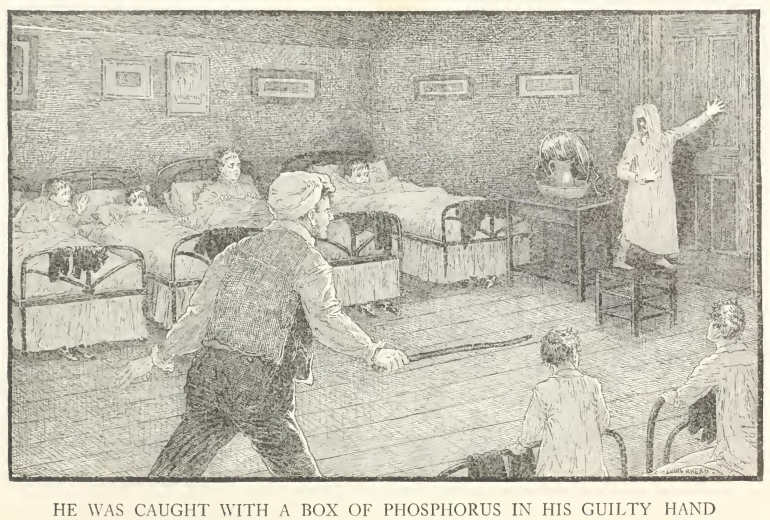
Original
He was a remarkable boy, and by no means a bad one. Tom stuck to him till he left, and got into many scrapes by so doing. But he was the great opponent of the tale-bearing habits of the school, and the open enemy of the ushers; and so worthy of all support.
Tom imbibed a fair amount of Latin and Greek at the school, but somehow, on the whole, it didn't suit him, or he it, and in the holidays he was constantly working the Squire to send him at once to a public school. Great was his joy then, when in the middle of his third half-year, in October 183-, a fever broke out in the village, and the master having himself slightly sickened of it, the whole of the boys were sent off at a day's notice to their respective homes.
The Squire was not quite so pleased as Master Tom to see that young gentleman's brown, merry face appear at home, some two months before the proper time, for the Christmas holidays; and so, after putting on his thinking cap, he retired to his study and wrote several letters, the result of which was that, one morning at the breakfast-table, about a fortnight after Tom's return, he addressed his wife with—“My dear, I have arranged that Tom shall go to Rugby at once, for the last six weeks of this half-year, instead of wasting them in riding and loitering about home. It is very kind of the doctor to allow it. Will you see that his things are all ready by Friday, when I shall take him up to town, and send him down the next day by himself.”
Mrs. Brown was prepared for the announcement, and merely suggested a doubt whether Tom were yet old enough to travel by himself. However, finding both father and son against her on this point, she gave in, like a wise woman, and proceeded to prepare Tom's kit for his launch into a public school.
Original
CHAPTER IV—THE STAGE COACH.
“Let the steam-pot hiss till it's hot; Give me the speed of the Tantivy trot.” Coaching Song, by R.E.E. Warburton, Esq.
 Original
ow, sir, time to get up, if you please. Tally-ho coach for Leicester'll be round in half an hour, and don't wait for nobody.” So spake the boots of the Peacock Inn Islington, at half-past two o'clock on the morning of a day in the early part of November 183-, giving Tom at the same time a shake by the shoulder, and then putting down a candle; and carrying off his shoes to clean.
Tom and his father arrived in town from Berkshire the day before, and finding, on inquiry, that the Birmingham coaches which ran from the city did not pass through Rugby, but deposited their passengers at Dunchurch, a village three miles distant on the main road, where said passengers had to wait for the Oxford and Leicester coach in the evening, or to take a post-chaise, had resolved that Tom should travel down by the Tally-ho, which diverged from the main road and passed through Rugby itself. And as the Tally-ho was an early coach, they had driven out to the Peacock to be on the road.
Tom had never been in London, and would have liked to have stopped at the Belle Savage, where they had been put down by the Star, just at dusk, that he might have gone roving about those endless, mysterious, gas-lit streets, which, with their glare and hum and moving crowds, excited him so that he couldn't talk even. But as soon as he found that the Peacock arrangement would get him to Rugby by twelve o'clock in the day, whereas otherwise he wouldn't be there till the evening, all other plans melted away, his one absorbing aim being to become a public school-boy as fast as possible, and six hours sooner or later seeming to him of the most alarming importance.
Tom and his father had alighted at the Peacock at about seven in the evening; and having heard with unfeigned joy the paternal order, at the bar, of steaks and oyster-sauce for supper in half an hour, and seen his father seated cozily by the bright fire in the coffee-room with the paper in his hand, Tom had run out to see about him, had wondered at all the vehicles passing and repassing, and had fraternized with the boots and hostler, from whom he ascertained that the Tally-ho was a tip-top goer—ten miles an hour including stoppages—and so punctual that all the road set their clocks by her.
Then being summoned to supper, he had regaled himself in one of the bright little boxes of the Peacock coffee-room, on the beef-steak and unlimited oyster-sauce and brown stout (tasted then for the first time—a day to be marked for ever by Tom with a white stone); had at first attended to the excellent advice which his father was bestowing on him from over his glass of steaming brandy-and-water, and then began nodding, from the united effects of the stout, the fire, and the lecture; till the Squire, observing Tom's state, and remembering that it was nearly nine o'clock, and that the Tally-ho left at three, sent the little fellow off to the chambermaid, with a shake of the hand (Tom having stipulated in the morning before starting that kissing should now cease between them), and a few parting words:
“And now, Tom, my boy,” said the Squire, “remember you are going, at your own earnest request, to be chucked into this great school, like a young bear, with all your troubles before you—earlier than we should have sent you perhaps. If schools are what they were in my time, you'll see a great many cruel blackguard things done, and hear a deal of foul, bad talk. But never fear. You tell the truth, keep a brave and kind heart, and never listen to or say anything you wouldn't have your mother and sister hear, and you'll never feel ashamed to come home, or we to see you.”
The allusion to his mother made Tom feel rather choky, and he would have liked to have hugged his father well, if it hadn't been for the recent stipulation.
As it was, he only squeezed his father's hand, and looked bravely up and said, “I'll try, father.”
“I know you will, my boy. Is your money all safe?
“Yes,” said Tom, diving into one pocket to make sure.
“And your keys?” said the Squire.
“All right,” said Tom, diving into the other pocket.
“Well, then, good-night. God bless you! I'll tell boots to call you, and be up to see you off.”
Tom was carried off by the chambermaid in a brown study, from which he was roused in a clean little attic, by that buxom person calling him a little darling and kissing him as she left the room; which indignity he was too much surprised to resent. And still thinking of his father's last words, and the look with which they were spoken, he knelt down and prayed that, come what might, he might never bring shame or sorrow on the dear folk at home.
Indeed, the Squire's last words deserved to have their effect, for they had been the result of much anxious thought. All the way up to London he had pondered what he should say to Tom by way of parting advice—something that the boy could keep in his head ready for use. By way of assisting meditation, he had even gone the length of taking out his flint and steel and tinder, and hammering away for a quarter of an hour till he had manufactured a light for a long Trichinopoli cheroot, which he silently puffed, to the no small wonder of coachee, who was an old friend, and an institution on the Bath road, and who always expected a talk on the prospects and doings, agricultural and social, of the whole country, when he carried the Squire.
To condense the Squire's meditation, it was somewhat as follows: “I won't tell him to read his Bible, and love and serve God; if he don't do that for his mother's sake and teaching, he won't for mine. Shall I go into the sort of temptations he'll meet with? No, I can't do that. Never do for an old fellow to go into such things with a boy. He won't understand me. Do him more harm than good, ten to one. Shall I tell him to mind his work, and say he's sent to school to make himself a good scholar? Well, but he isn't sent to school for that—at any rate, not for that mainly. I don't care a straw for Greek particles, or the digamma; no more does his mother. What is he sent to school for? Well, partly because he wanted so to go. If he'll only turn out a brave, helpful, truth-telling Englishman, and a gentleman, and a Christian, that's all I want,” thought the Squire; and upon this view of the case he framed his last words of advice to Tom, which were well enough suited to his purpose.
For they were Tom's first thoughts as he tumbled out of bed at the summons of boots, and proceeded rapidly to wash and dress himself. At ten minutes to three he was down in the coffee-room in his stockings, carrying his hat-box, coat, and comforter in his hand; and there he found his father nursing a bright fire, and a cup of hot coffee and a hard biscuit on the table.
“Now, then, Tom, give us your things here, and drink this. There's nothing like starting warm, old fellow.”
Tom addressed himself to the coffee, and prattled away while he worked himself into his shoes and his greatcoat, well warmed through—a Petersham coat with velvet collar, made tight after the abominable fashion of those days. And just as he is swallowing his last mouthful, winding his comforter round his throat, and tucking the ends into the breast of his coat, the horn sounds; boots looks in and says, “Tally-ho, sir;” and they hear the ring and the rattle of the four fast trotters and the town-made drag, as it dashes up to the Peacock.
“Anything for us, Bob?” says the burly guard, dropping down from behind, and slapping himself across the chest.
“Young gen'lm'n, Rugby; three parcels, Leicester; hamper o' game, Rugby,” answers hostler.
“Tell young gent to look alive,” says guard, opening the hind-boot and shooting in the parcels after examining them by the lamps. “Here; shove the portmanteau up a-top. I'll fasten him presently.—Now then, sir, jump up behind.”
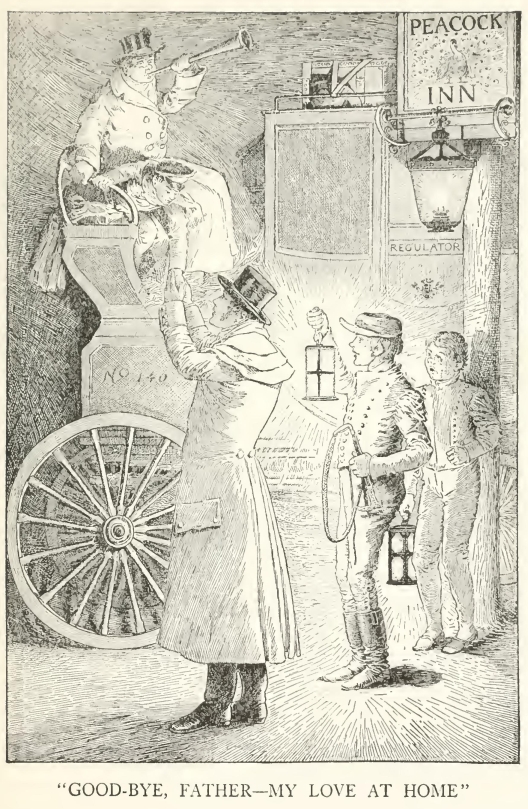
Original
“Good-bye, father—my love at home.” A last shake of the hand. Up goes Tom, the guard catching his hatbox and holding on with one hand, while with the other he claps the horn to his mouth. Toot, toot, toot! the hostlers let go their heads, the four bays plunge at the collar, and away goes the Tally-ho into the darkness, forty-five seconds from the time they pulled up. Hostler, boots, and the Squire stand looking after them under the Peacock lamp.
“Sharp work!” says the Squire, and goes in again to his bed, the coach being well out of sight and hearing.
Tom stands up on the coach and looks back at his father's figure as long as he can see it; and then the guard, having disposed of his luggage, comes to an anchor, and finishes his buttonings and other preparations for facing the three hours before dawn—no joke for those who minded cold, on a fast coach in November, in the reign of his late Majesty.
I sometimes think that you boys of this generation are a deal tenderer fellows than we used to be. At any rate you're much more comfortable travellers, for I see every one of you with his rug or plaid, and other dodges for preserving the caloric, and most of you going in, those fuzzy, dusty, padded first-class carriages. It was another affair altogether, a dark ride on the top of the Tally-ho, I can tell you, in a tight Petersham coat, and your feet dangling six inches from the floor. Then you knew what cold was, and what it was to be without legs, for not a bit of feeling had you in them after the first half-hour. But it had its pleasures, the old dark ride. First there was the consciousness of silent endurance, so dear to every Englishman—of standing out against something, and not giving in. Then there was the music of the rattling harness, and the ring of the horses' feet on the hard road, and the glare of the two bright lamps through the steaming hoar frost, over the leaders' ears, into the darkness, and the cheery toot of the guard's horn, to warn some drowsy pikeman or the hostler at the next change; and the looking forward to daylight; and last, but not least, the delight of returning sensation in your toes.
Then the break of dawn and the sunrise, where can they be ever seen in perfection but from a coach roof? You want motion and change and music to see them in their glory—not the music of singing men and singing women, but good, silent music, which sets itself in your own head, the accompaniment of work and getting over the ground.
The Tally-ho is past St. Albans, and Tom is enjoying the ride, though half-frozen. The guard, who is alone with him on the back of the coach, is silent, but has muffled Tom's feet up in straw, and put the end of an oat-sack over his knees. The darkness has driven him inwards, and he has gone over his little past life, and thought of all his doings and promises, and of his mother and sister, and his father's last words; and has made fifty good resolutions, and means to bear himself like a brave Brown as he is, though a young one. Then he has been forward into the mysterious boy-future, speculating as to what sort of place Rugby is, and what they do there, and calling up all the stories of public schools which he has heard from big boys in the holidays. He is choke-full of hope and life, notwithstanding the cold, and kicks his heels against the back-board, and would like to sing, only he doesn't know how his friend the silent guard might take it.
And now the dawn breaks at the end of the fourth stage, and the coach pulls up at a little roadside inn with huge stables behind. There is a bright fire gleaming through the red curtains of the bar window, and the door is open. The coachman catches his whip into a double thong, and throws it to the hostler; the steam of the horses rises straight up into the air. He has put them along over the last two miles, and is two minutes before his time. He rolls down from the box and into the inn. The guard rolls off behind. “Now, sir,” says he to Tom, “you just jump down, and I'll give you a drop of something to keep the cold out.”
Tom finds a difficulty in jumping, or indeed in finding the top of the wheel with his feet, which may be in the next world for all he feels; so the guard picks him off the coach top, and sets him on his legs, and they stump off into the bar, and join the coachman and the other outside passengers.
Here a fresh-looking barmaid serves them each with a glass of early purl as they stand before the fire, coachman and guard exchanging business remarks. The purl warms the cockles of Tom's heart, and makes him cough.
“Rare tackle that, sir, of a cold morning,” says the coachman, smiling. “Time's up.” They are out again and up; coachee the last, gathering the reins into his hands and talking to Jem the hostler about the mare's shoulder, and then swinging himself up on to the box—the horses dashing off in a canter before he falls into his seat. Toot-toot-tootle-too goes the horn, and away they are again, five-and-thirty miles on their road (nearly half-way to Rugby, thinks Tom), and the prospect of breakfast at the end of the stage.
And now they begin to see, and the early life of the country-side comes out—a market cart or two; men in smock-frocks going to their work, pipe in mouth, a whiff of which is no bad smell this bright morning. The sun gets up, and the mist shines like silver gauze. They pass the hounds jogging along to a distant meet, at the heels of the huntsman's back, whose face is about the colour of the tails of his old pink, as he exchanges greetings with coachman and guard. Now they pull up at a lodge, and take on board a well-muffled-up sportsman, with his gun-case and carpet-bag, An early up-coach meets them, and the coachmen gather up their horses, and pass one another with the accustomed lift of the elbow, each team doing eleven miles an hour, with a mile to spare behind if necessary. And here comes breakfast.
“Twenty minutes here, gentlemen,” says the coachman, as they pull up at half-past seven at the inn-door.
Have we not endured nobly this morning? and is not this a worthy reward for much endurance? There is the low, dark wainscoted room hung with sporting prints; the hat-stand (with a whip or two standing up in it belonging to bagmen who are still snug in bed) by the door; the blazing fire, with the quaint old glass over the mantelpiece, in which is stuck a large card with the list of the meets for the week of the county hounds; the table covered with the whitest of cloths and of china, and bearing a pigeon-pie, ham, round of cold boiled beef cut from a mammoth ox, and the great loaf of household bread on a wooden trencher. And here comes in the stout head waiter, puffing under a tray of hot viands—kidneys and a steak, transparent rashers and poached eggs, buttered toast and muffins, coffee and tea, all smoking hot. The table can never hold it all. The cold meats are removed to the sideboard—they were only put on for show and to give us an appetite. And now fall on, gentlemen all. It is a well-known sporting-house, and the breakfasts are famous. Two or three men in pink, on their way to the meet, drop in, and are very jovial and sharp-set, as indeed we all are.
“Tea or coffee, sir?” says head waiter, coming round to Tom.
“Coffee, please,” says Tom, with his mouth full of muffin and kidney. Coffee is a treat to him, tea is not.
Our coachman, I perceive, who breakfasts with us, is a cold beef man. He also eschews hot potations, and addicts himself to a tankard of ale, which is brought him by the barmaid. Sportsman looks on approvingly, and orders a ditto for himself.
Tom has eaten kidney and pigeon-pie, and imbibed coffee, till his little skin is as tight as a drum; and then has the further pleasure of paying head waiter out of his own purse, in a dignified manner, and walks out before the inn-door to see the horses put to. This is done leisurely and in a highly-finished manner by the hostlers, as if they enjoyed the not being hurried. Coachman comes out with his waybill, and puffing a fat cigar which the sportsman has given him. Guard emerges from the tap, where he prefers breakfasting, licking round a tough-looking doubtful cheroot, which you might tie round your finger, and three whiffs of which would knock any one else out of time.
The pinks stand about the inn-door lighting cigars and waiting to see us start, while their hacks are led up and down the market-place, on which the inn looks. They all know our sportsman, and we feel a reflected credit when we see him chatting and laughing with them.
“Now, sir, please,” says the coachman. All the rest of the passengers are up; the guard is locking up the hind-boot.
“A good run to you!” says the sportsman to the pinks, and is by the coachman's side in no time.
“Let 'em go, Dick!” The hostlers fly back, drawing off the cloths from their glossy loins, and away we go through the market-place and down the High Street, looking in at the first-floor windows, and seeing several worthy burgesses shaving thereat; while all the shopboys who are cleaning the windows, and housemaids who are doing the steps, stop and look pleased as we rattle past, as if we were a part of their legitimate morning's amusement. We clear the town, and are well out between the hedgerows again as the town clock strikes eight.
The sun shines almost warmly, and breakfast has oiled all springs and loosened all tongues. Tom is encouraged by a remark or two of the guard's between the puffs of his oily cheroot, and besides is getting tired of not talking. He is too full of his destination to talk about anything else, and so asks the guard if he knows Rugby.
“Goes through it every day of my life. Twenty minutes afore twelve down—ten o'clock up.”
“What sort of place is it, please?” says Tom.
Guard looks at him with a comical expression. “Werry out-o'-the-way place, sir; no paving to streets, nor no lighting. 'Mazin' big horse and cattle fair in autumn—lasts a week—just over now. Takes town a week to get clean after it. Fairish hunting country. But slow place, sir, slow place—off the main road, you see—only three coaches a day, and one on 'em a two-oss wan, more like a hearse nor a coach—Regulator—comes from Oxford. Young genl'm'n at school calls her Pig and Whistle, and goes up to college by her (six miles an hour) when they goes to enter. Belong to school, sir?”
“Yes,” says Tom, not unwilling for a moment that the guard should think him an old boy. But then, having some qualms as to the truth of the assertion, and seeing that if he were to assume the character of an old boy he couldn't go on asking the questions he wanted, added—“That is to say, I'm on my way there. I'm a new boy.”
The guard looked as if he knew this quite as well as Tom.
“You're werry late, sir,” says the guard; “only six weeks to-day to the end of the half.” Tom assented. “We takes up fine loads this day six weeks, and Monday and Tuesday arter. Hopes we shall have the pleasure of carrying you back.”
Tom said he hoped they would; but he thought within himself that his fate would probably be the Pig and Whistle.
“It pays uncommon cert'nly,” continues the guard. “Werry free with their cash is the young genl'm'n. But, Lor' bless you, we gets into such rows all 'long the road, what wi' their pea-shooters, and long whips, and hollering, and upsetting every one as comes by, I'd a sight sooner carry one or two on 'em, sir, as I may be a-carryin' of you now, than a coach-load.”
“What do they do with the pea-shooters?” inquires Tom.
“Do wi' 'em! Why, peppers every one's faces as we comes near, 'cept the young gals, and breaks windows wi' them too, some on 'em shoots so hard. Now 'twas just here last June, as we was a-driving up the first-day boys, they was mendin' a quarter-mile of road, and there was a lot of Irish chaps, reg'lar roughs, a-breaking stones. As we comes up, 'Now, boys,' says young gent on the box (smart young fellow and desper't reckless), 'here's fun! Let the Pats have it about the ears.' 'God's sake sir!' says Bob (that's my mate the coachman); 'don't go for to shoot at 'em. They'll knock us off the coach.' 'Damme, coachee,' says young my lord, 'you ain't afraid.—Hoora, boys! let 'em have it.' 'Hoora!' sings out the others, and fill their mouths choke-full of peas to last the whole line. Bob, seeing as 'twas to come, knocks his hat over his eyes, hollers to his osses, and shakes 'em up; and away we goes up to the line on 'em, twenty miles an hour. The Pats begin to hoora too, thinking it was a runaway; and first lot on 'em stands grinnin' and wavin' their old hats as we comes abreast on 'em; and then you'd ha' laughed to see how took aback and choking savage they looked, when they gets the peas a-stinging all over 'em. But bless you, the laugh weren't all of our side, sir, by a long way. We was going so fast, and they was so took aback, that they didn't take what was up till we was half-way up the line. Then 'twas, 'Look out all!' surely. They howls all down the line fit to frighten you; some on 'em runs arter us and tries to clamber up behind, only we hits 'em over the fingers and pulls their hands off; one as had had it very sharp act'ly runs right at the leaders, as though he'd ketch 'em by the heads, only luck'ly for him he misses his tip and comes over a heap o' stones first. The rest picks up stones, and gives it us right away till we gets out of shot, the young gents holding out werry manful with the pea-shooters and such stones as lodged on us, and a pretty many there was too. Then Bob picks hisself up again, and looks at young gent on box werry solemn. Bob'd had a rum un in the ribs, which'd like to ha' knocked him off the box, or made him drop the reins. Young gent on box picks hisself up, and so does we all, and looks round to count damage. Box's head cut open and his hat gone; 'nother young gent's hat gone; mine knocked in at the side, and not one on us as wasn't black and blue somewheres or another, most on 'em all over. Two pound ten to pay for damage to paint, which they subscribed for there and then, and give Bob and me a extra half-sovereign each; but I wouldn't go down that line again not for twenty half-sovereigns.” And the guard shook his head slowly, and got up and blew a clear, brisk toot-toot.
“What fun!” said Tom, who could scarcely contain his pride at this exploit of his future school-fellows. He longed already for the end of the half, that he might join them.
“'Taint such good fun, though, sir, for the folk as meets the coach, nor for we who has to go back with it next day. Them Irishers last summer had all got stones ready for us, and was all but letting drive, and we'd got two reverend gents aboard too. We pulled up at the beginning of the line, and pacified them, and we're never going to carry no more pea-shooters, unless they promises not to fire where there's a line of Irish chaps a-stonebreaking.” The guard stopped and pulled away at his cheroot, regarding Tom benignantly the while.
“Oh, don't stop! Tell us something more about the pea-shooting.”
“Well, there'd like to have been a pretty piece of work over it at Bicester, a while back. We was six mile from the town, when we meets an old square-headed gray-haired yeoman chap, a-jogging along quite quiet. He looks up at the coach, and just then a pea hits him on the nose, and some catches his cob behind and makes him dance up on his hind legs. I see'd the old boy's face flush and look plaguy awkward, and I thought we was in for somethin' nasty.
“He turns his cob's head and rides quietly after us just out of shot. How that 'ere cob did step! We never shook him off not a dozen yards in the six miles. At first the young gents was werry lively on him; but afore we got in, seeing how steady the old chap come on, they was quite quiet, and laid their heads together what they should do. Some was for fighting, some for axing his pardon. He rides into the town close after us, comes up when we stops, and says the two as shot at him must come before a magistrate; and a great crowd comes round, and we couldn't get the osses to. But the young uns they all stand by one another, and says all or none must go, and as how they'd fight it out, and have to be carried. Just as 'twas gettin' serious, and the old boy and the mob was going to pull 'em off the coach, one little fellow jumps up and says, 'Here—I'll stay. I'm only going three miles farther. My father's name's Davis; he's known about here, and I'll go before the magistrate with this gentleman.' 'What! be thee parson Davis's son?' says the old boy. 'Yes,' says the young un. 'Well, I be mortal sorry to meet thee in such company; but for thy father's sake and thine (for thee bist a brave young chap) I'll say no more about it.' Didn't the boys cheer him, and the mob cheered the young chap; and then one of the biggest gets down, and begs his pardon werry gentlemanly for all the rest, saying as they all had been plaguy vexed from the first, but didn't like to ax his pardon till then, 'cause they felt they hadn't ought to shirk the consequences of their joke. And then they all got down, and shook hands with the old boy, and asked him to all parts of the country, to their homes; and we drives off twenty minutes behind time, with cheering and hollering as if we was county 'members. But, Lor' bless you, sir,” says the guard, smacking his hand down on his knee and looking full into Tom's face, “ten minutes arter they was all as bad as ever.”
Tom showed such undisguised and open-mouthed interest in his narrations that the old guard rubbed up his memory, and launched out into a graphic history of all the performances of the boys on the roads for the last twenty years. Off the road he couldn't go; the exploit must have been connected with horses or vehicles to hang in the old fellow's head. Tom tried him off his own ground once or twice, but found he knew nothing beyond, and so let him have his head, and the rest of the road bowled easily away; for old Blow-hard (as the boys called him) was a dry old file, with much kindness and humour, and a capital spinner of a yarn when he had broken the neck of his day's work, and got plenty of ale under his belt.
What struck Tom's youthful imagination most was the desperate and lawless character of most of the stories. Was the guard hoaxing him? He couldn't help hoping that they were true. It's very odd how almost all English boys love danger. You can get ten to join a game, or climb a tree, or swim a stream, when there's a chance of breaking their limbs or getting drowned, for one who'll stay on level ground, or in his depth, or play quoits or bowls.
The guard had just finished an account of a desperate fight which had happened at one of the fairs between the drovers and the farmers with their whips, and the boys with cricket-bats and wickets, which arose out of a playful but objectionable practice of the boys going round to the public-houses and taking the linch-pins out of the wheels of the gigs, and was moralizing upon the way in which the Doctor, “a terrible stern man he'd heard tell,” had come down upon several of the performers, “sending three on 'em off next morning in a po-shay with a parish constable,” when they turned a corner and neared the milestone, the third from Rugby. By the stone two boys stood, their jackets buttoned tight, waiting for the coach.
“Look here, sir,” says the guard, after giving a sharp toot-toot; “there's two on 'em; out-and-out runners they be. They comes out about twice or three times a week, and spirts a mile alongside of us.”
And as they came up, sure enough, away went two boys along the foot-path, keeping up with the horses—the first a light, clean-made fellow going on springs; the other stout and round-shouldered, labouring in his pace, but going as dogged as a bull-terrier.
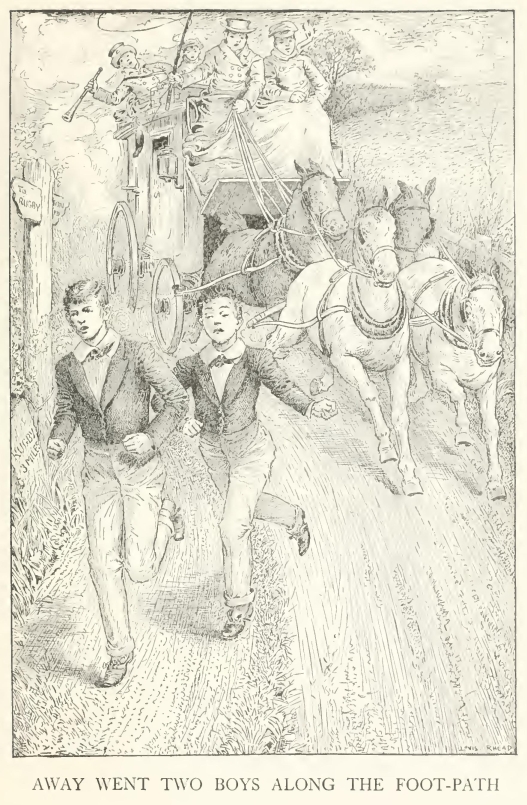
Original
Old Blow-hard looked on admiringly. “See how beautiful that there un holds hisself together, and goes from his hips, sir,” said he; “he's a 'mazin' fine runner. Now many coachmen as drives a first-rate team'd put it on, and try and pass 'em. But Bob, sir, bless you, he's tender-hearted; he'd sooner pull in a bit if he see'd 'em a-gettin' beat. I do b'lieve, too, as that there un'd sooner break his heart than let us go by him afore next milestone.”
At the second milestone the boys pulled up short, and waved their hats to the guard, who had his watch out and shouted “4.56,” thereby indicating that the mile had been done in four seconds under the five minutes. They passed several more parties of boys, all of them objects of the deepest interest to Tom, and came in sight of the town at ten minutes before twelve. Tom fetched a long breath, and thought he had never spent a pleasanter day. Before he went to bed he had quite settled that it must be the greatest day he should ever spend, and didn't alter his opinion for many a long year—if he has yet.
Original
CHAPTER V—RUGBY AND FOOTBALL.
“Foot and eye opposed In dubious strife.”—Scott.
 Original
nd so here's Rugby, sir, at last, and you'll be in plenty of time for dinner at the School-house, as I telled you,” said the old guard, pulling his horn out of its case and tootle-tooing away, while the coachman shook up his horses, and carried them along the side of the school close, round Dead-man's corner, past the school-gates, and down the High Street to the Spread Eagle, the wheelers in a spanking trot, and leaders cantering, in a style which would not have disgraced “Cherry Bob,” “ramping, stamping, tearing, swearing Billy Harwood,” or any other of the old coaching heroes.
Tom's heart beat quick as he passed the great schoolfield or close, with its noble elms, in which several games at football were going on, and tried to take in at once the long line of gray buildings, beginning with the chapel, and ending with the School-house, the residence of the head-master, where the great flag was lazily waving from the highest round tower. And he began already to be proud of being a Rugby boy, as he passed the schoolgates, with the oriel window above, and saw the boys standing there, looking as if the town belonged to them, and nodding in a familiar manner to the coachman, as if any one of them would be quite equal to getting on the box, and working the team down street as well as he.
One of the young heroes, however, ran out from the rest, and scrambled up behind; where, having righted himself, and nodded to the guard, with “How do, Jem?” he turned short round to Tom, and after looking him over for a minute, began,—
“I say, you fellow, is your name Brown?”
“Yes,” said Tom, in considerable astonishment, glad, however, to have lighted on some one already who seemed to know him.
“Ah, I thought so. You know my old aunt, Miss East. She lives somewhere down your way in Berkshire. She wrote to me that you were coming to-day, and asked me to give you a lift.”
Tom was somewhat inclined to resent the patronizing air of his new friend, a boy of just about his own height and age, but gifted with the most transcendent coolness and assurance, which Tom felt to be aggravating and hard to bear, but couldn't for the life of him help admiring and envying—especially when young my lord begins hectoring two or three long loafing fellows, half porter, half stableman, with a strong touch of the blackguard, and in the end arranges with one of them, nicknamed Cooey, to carry Tom's luggage up to the School-house for sixpence.
“And hark 'ee, Cooey; it must be up in ten minutes, or no more jobs from me. Come along, Brown.” And away swaggers the young potentate, with his hands in his pockets, and Tom at his side.
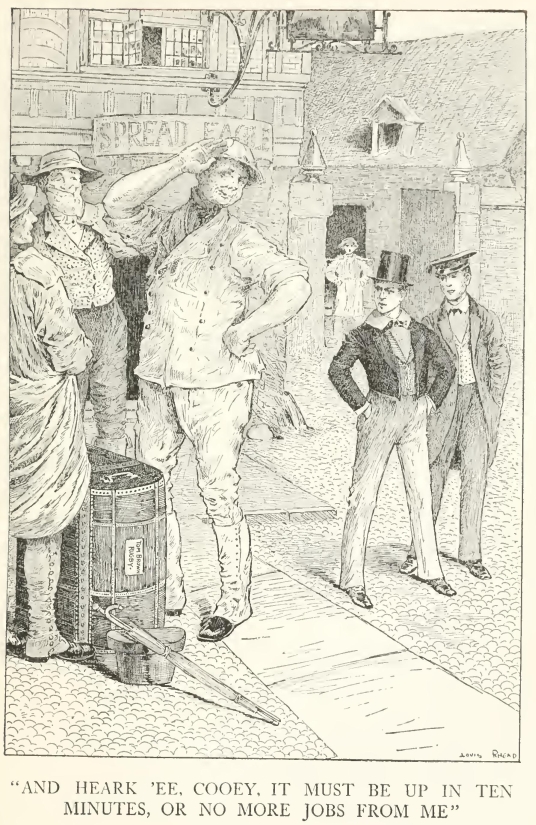
Original
“All right, sir,” says Cooey, touching his hat, with a leer and a wink at his companions.
“Hullo though,” says East, pulling up, and taking another look at Tom; “this'll never do. Haven't you got a hat? We never wear caps here. Only the louts wear caps. Bless you, if you were to go into the quadrangle with that thing on, I don't know what'd happen.” The very idea was quite beyond young Master East, and he looked unutterable things.
Tom thought his cap a very knowing affair, but confessed that he had a hat in his hat-box; which was accordingly at once extracted from the hind-boot, and Tom equipped in his go-to-meeting roof, as his new friend called it. But this didn't quite suit his fastidious taste in another minute, being too shiny; so, as they walk up the town, they dive into Nixon's the hatter's, and Tom is arrayed, to his utter astonishment, and without paying for it, in a regulation cat-skin at seven-and-sixpence, Nixon undertaking to send the best hat up to the matron's room, School-house, in half an hour.
“You can send in a note for a tile on Monday, and make it all right, you know,” said Mentor; “we're allowed two seven-and-sixers a half, besides what we bring from home.”
Tom by this time began to be conscious of his new social position and dignities, and to luxuriate in the realized ambition of being a public school-boy at last, with a vested right of spoiling two seven-and-sixers in half a year.
“You see,” said his friend, as they strolled up towards the school-gates, in explanation of his conduct, “a great deal depends on how a fellow cuts up at first. If he's got nothing odd about him, and answers straightforward, and holds his head up, he gets on. Now, you'll do very well as to rig, all but that cap. You see I'm doing the handsome thing by you, because my father knows yours; besides, I want to please the old lady. She gave me half a sov. this half, and perhaps'll double it next, if I keep in her good books.”
There's nothing for candour like a lower-school boy, and East was a genuine specimen—frank, hearty, and good-natured, well-satisfied with himself and his position, and choke-full of life and spirits, and all the Rugby prejudices and traditions which he had been able to get together in the long course of one half-year during which he had been at the School-house.
And Tom, notwithstanding his bumptiousness, felt friends with him at once, and began sucking in all his ways and prejudices, as fast as he could understand them.
East was great in the character of cicerone. He carried Tom through the great gates, where were only two or three boys. These satisfied themselves with the stock questions, “You fellow, what's your name? Where do you come from? How old are you? Where do you board?” and, “What form are you in?” And so they passed on through the quadrangle and a small courtyard, upon which looked down a lot of little windows (belonging, as his guide informed him, to some of the School-house studies), into the matron's room, where East introduced Tom to that dignitary; made him give up the key of his trunk, that the matron might unpack his linen, and told the story of the hat and of his own presence of mind: upon the relation whereof the matron laughingly scolded him for the coolest new boy in the house; and East, indignant at the accusation of newness, marched Tom off into the quadrangle, and began showing him the schools, and examining him as to his literary attainments; the result of which was a prophecy that they would be in the same form, and could do their lessons together.
“And now come in and see my study—we shall have just time before dinner; and afterwards, before calling over, we'll do the close.”
Tom followed his guide through the School-house hall, which opens into the quadrangle. It is a great room, thirty feet long and eighteen high, or thereabouts, with two great tables running the whole length, and two large fireplaces at the side, with blazing fires in them, at one of which some dozen boys were standing and lounging, some of whom shouted to East to stop; but he shot through with his convoy, and landed him in the long, dark passages, with a large fire at the end of each, upon which the studies opened. Into one of these, in the bottom passage, East bolted with our hero, slamming and bolting the door behind them, in case of pursuit from the hall, and Tom was for the first time in a Rugby boy's citadel.
He hadn't been prepared for separate studies, and was not a little astonished and delighted with the palace in question.
It wasn't very large, certainly, being about six feet long by four broad. It couldn't be called light, as there were bars and a grating to the window; which little precautions were necessary in the studies on the ground-floor looking out into the close, to prevent the exit of small boys after locking up, and the entrance of contraband articles. But it was uncommonly comfortable to look at, Tom thought. The space under the window at the farther end was occupied by a square table covered with a reasonably clean and whole red and blue check tablecloth; a hard-seated sofa covered with red stuff occupied one side, running up to the end, and making a seat for one, or by sitting close, for two, at the table and a good stout wooden chair afforded a seat to another boy, so that three could sit and work together. The walls were wainscoted half-way up, the wainscot being covered with green baize, the remainder with a bright-patterned paper, on which hung three or four prints of dogs' heads; Grimaldi winning the Aylesbury steeple-chase; Amy Robsart, the reigning Waverley beauty of the day; and Tom Crib, in a posture of defence, which did no credit to the science of that hero, if truly represented. Over the door were a row of hat-pegs, and on each side bookcases with cupboards at the bottom, shelves and cupboards being filled indiscriminately with school-books, a cup or two, a mouse-trap and candlesticks, leather straps, a fustian bag, and some curious-looking articles which puzzled Tom not a little, until his friend explained that they were climbing-irons, and showed their use. A cricket-bat and small fishing-rod stood up in one corner.
This was the residence of East and another boy in the same form, and had more interest for Tom than Windsor Castle, or any other residence in the British Isles. For was he not about to become the joint owner of a similar home, the first place he could call his own? One's own! What a charm there is in the words! How long it takes boy and man to find out their worth! How fast most of us hold on to them—faster and more jealously, the nearer we are to that general home into which we can take nothing, but must go naked as we came into the world! When shall we learn that he who multiplieth possessions multiplieth troubles, and that the one single use of things which we call our own is that they may be his who hath need of them?
“And shall I have a study like this too?” said Tom.
“Yes, of course; you'll be chummed with some fellow on Monday, and you can sit here till then.”
“What nice places!”
“They're well enough,” answered East, patronizingly, “only uncommon cold at nights sometimes. Gower—that's my chum—and I make a fire with paper on the floor after supper generally, only that makes it so smoky.”
“But there's a big fire out in the passage,” said Tom.
“Precious little we get out of that, though,” said East. “Jones the praepostor has the study at the fire end, and he has rigged up an iron rod and green baize curtain across the passage, which he draws at night, and sits there with his door open; so he gets all the fire, and hears if we come out of our studies after eight, or make a noise. However, he's taken to sitting in the fifth-form room lately, so we do get a bit of fire now sometimes; only to keep a sharp lookout that he don't catch you behind his curtain when he comes down—that's all.”
A quarter past one now struck, and the bell began tolling for dinner; so they went into the hall and took their places, Tom at the very bottom of the second table, next to the praepostor (who sat at the end to keep order there), and East a few paces higher. And now Tom for the first time saw his future school-fellows in a body. In they came, some hot and ruddy from football or long walks, some pale and chilly from hard reading in their studies, some from loitering over the fire at the pastrycook's, dainty mortals, bringing with them pickles and saucebottles to help them with their dinners. And a great big-bearded man, whom Tom took for a master, began calling over the names, while the great joints were being rapidly carved on the third table in the corner by the old verger and the housekeeper. Tom's turn came last, and meanwhile he was all eyes, looking first with awe at the great man, who sat close to him, and was helped first, and who read a hard-looking book all the time he was eating; and when he got up and walked off to the fire, at the small boys round him, some of whom were reading, and the rest talking in whispers to one another, or stealing one another's bread, or shooting pellets, or digging their forks through the tablecloth. However, notwithstanding his curiosity, he managed to make a capital dinner by the time the big man called “Stand up!” and said grace.
As soon as dinner was over, and Tom had been questioned by such of his neighbours as were curious as to his birth, parentage, education, and other like matters, East, who evidently enjoyed his new dignity of patron and mentor, proposed having a look at the close, which Tom, athirst for knowledge, gladly assented to; and they went out through the quadrangle and past the big fives court, into the great playground.
“That's the chapel, you see,” said East; “and there, just behind it, is the place for fights. You see it's most out of the way of the masters, who all live on the other side, and don't come by here after first lesson or callings-over. That's when the fights come off. And all this part where we are is the little-side ground, right up to the trees; and on the other side of the trees is the big-side ground, where the great matches are played. And there's the island in the farthest corner; you'll know that well enough next half, when there's island fagging. I say, it's horrid cold; let's have a run across.” And away went East, Tom close behind him. East was evidently putting his best foot foremost; and Tom, who was mighty proud of his running, and not a little anxious to show his friend that, although a new boy, he was no milksop, laid himself down to work in his very best style. Right across the close they went, each doing all he knew, and there wasn't a yard between them when they pulled up at the island moat.
“I say,” said East, as soon as he got his wind, looking with much increased respect at Tom, “you ain't a bad scud, not by no means. Well, I'm as warm as a toast now.”
“But why do you wear white trousers in November?” said Tom. He had been struck by this peculiarity in the costume of almost all the School-house boys.
“Why, bless us, don't you know? No; I forgot. Why, to-day's the School-house match. Our house plays the whole of the School at football. And we all wear white trousers, to show 'em we don't care for hacks. You're in luck to come to-day. You just will see a match; and Brooke's going to let me play in quarters. That's more than he'll do for any other lower-school boy, except James, and he's fourteen.”
“Who's Brooke?”
“Why, that big fellow who called over at dinner, to be sure. He's cock of the school, and head of the School-house side, and the best kick and charger in Rugby.”
“Oh, but do show me where they play. And tell me about it. I love football so, and have played all my life. Won't Brooke let me play?”
“Not he,” said East, with some indignation. “Why, you don't know the rules; you'll be a month learning them. And then it's no joke playing-up in a match, I can tell you—quite another thing from your private school games. Why, there's been two collar-bones broken this half, and a dozen fellows lamed. And last year a fellow had his leg broken.”
Tom listened with the profoundest respect to this chapter of accidents, and followed East across the level ground till they came to a sort of gigantic gallows of two poles, eighteen feet high, fixed upright in the ground some fourteen feet apart, with a cross-bar running from one to the other at the height of ten feet or thereabouts.
“This is one of the goals,” said East, “and you see the other, across there, right opposite, under the Doctor's wall. Well, the match is for the best of three goals; whichever side kicks two goals wins: and it won't do, you see, just to kick the ball through these posts—it must go over the cross-bar; any height'll do, so long as it's between the posts. You'll have to stay in goal to touch the ball when it rolls behind the posts, because if the other side touch it they have a try at goal. Then we fellows in quarters, we play just about in front of goal here, and have to turn the ball and kick it back before the big fellows on the other side can follow it up. And in front of us all the big fellows play, and that's where the scrummages are mostly.”
Tom's respect increased as he struggled to make out his friend's technicalities, and the other set to work to explain the mysteries of “off your side,” “drop-kicks,” “punts,” “places,” and the other intricacies of the great science of football.
“But how do you keep the ball between the goals?” said he; “I can't see why it mightn't go right down to the chapel.”
“Why; that's out of play,” answered East. “You see this gravel-walk running down all along this side of the playing-ground, and the line of elms opposite on the other? Well, they're the bounds. As soon as the ball gets past them, it's in touch, and out of play. And then whoever first touches it has to knock it straight out amongst the players-up, who make two lines with a space between them, every fellow going on his own side. Ain't there just fine scrummages then! And the three trees you see there which come out into the play, that's a tremendous place when the ball hangs there, for you get thrown against the trees, and that's worse than any hack.”
Tom wondered within himself, as they strolled back again towards the fives court, whether the matches were really such break-neck affairs as East represented, and whether, if they were, he should ever get to like them and play up well.
He hadn't long to wonder, however, for next minute East cried out, “Hurrah! here's the punt-about; come along and try your hand at a kick.” The punt-about is the practice-ball, which is just brought out and kicked about anyhow from one boy to another before callings-over and dinner, and at other odd times. They joined the boys who had brought it out, all small School-house fellows, friends of East; and Tom had the pleasure of trying his skill, and performed very creditably, after first driving his foot three inches into the ground, and then nearly kicking his leg into the air, in vigorous efforts to accomplish a drop-kick after the manner of East.
Presently more boys and bigger came out, and boys from other houses on their way to calling-over, and more balls were sent for. The crowd thickened as three o'clock approached; and when the hour struck, one hundred and fifty boys were hard at work. Then the balls were held, the master of the week came down in cap and gown to calling-over, and the whole school of three hundred boys swept into the big school to answer to their names.
“I may come in, mayn't I?” said Tom, catching East by the arm, and longing to feel one of them.
“Yes, come along; nobody'll say anything. You won't be so eager to get into calling-over after a month,” replied his friend; and they marched into the big school together, and up to the farther end, where that illustrious form, the lower fourth, which had the honour of East's patronage for the time being, stood.
The master mounted into the high desk by the door, and one of the praepostors of the week stood by him on the steps, the other three marching up and down the middle of the school with their canes, calling out, “Silence, silence!” The sixth form stood close by the door on the left, some thirty in number, mostly great big grown men, as Tom thought, surveying them from a distance with awe; the fifth form behind them, twice their number, and not quite so big. These on the left; and on the right the lower fifth, shell, and all the junior forms in order; while up the middle marched the three praepostors.
Then the praepostor who stands by the master calls out the names, beginning with the sixth form; and as he calls each boy answers “here” to his name, and walks out. Some of the sixth stop at the door to turn the whole string of boys into the close. It is a great match-day, and every boy in the school, will he, nill he, must be there. The rest of the sixth go forwards into the close, to see that no one escapes by any of the side gates.
To-day, however, being the School-house match, none of the School-house praepostors stay by the door to watch for truants of their side; there is carte blanche to the School-house fags to go where they like. “They trust to our honour,” as East proudly informs Tom; “they know very well that no School-house boy would cut the match. If he did, we'd very soon cut him, I can tell you.”
The master of the week being short-sighted, and the praepostors of the week small and not well up to their work, the lower-school boys employ the ten minutes which elapse before their names are called in pelting one another vigorously with acorns, which fly about in all directions. The small praepostors dash in every now and then, and generally chastise some quiet, timid boy who is equally afraid of acorns and canes, while the principal performers get dexterously out of the way. And so calling-over rolls on somehow, much like the big world, punishments lighting on wrong shoulders, and matters going generally in a queer, cross-grained way, but the end coming somehow, which is, after all, the great point. And now the master of the week has finished, and locked up the big school; and the praepostors of the week come out, sweeping the last remnant of the school fags, who had been loafing about the corners by the fives court, in hopes of a chance of bolting, before them into the close.
“Hold the punt-about!” “To the goals!” are the cries; and all stray balls are impounded by the authorities, and the whole mass of boys moves up towards the two goals, dividing as they go into three bodies. That little band on the left, consisting of from fifteen to twenty boys, Tom amongst them, who are making for the goal under the School-house wall, are the School-house boys who are not to play up, and have to stay in goal. The larger body moving to the island goal are the School boys in a like predicament. The great mass in the middle are the players-up, both sides mingled together; they are hanging their jackets (and all who mean real work), their hats, waistcoats, neck-handkerchiefs, and braces, on the railings round the small trees; and there they go by twos and threes up to their respective grounds. There is none of the colour and tastiness of get-up, you will perceive, which lends such a life to the present game at Rugby, making the dullest and worst-fought match a pretty sight. Now each house has its own uniform of cap and jersey, of some lively colour; but at the time we are speaking of plush caps have not yet come in, or uniforms of any sort, except the School-house white trousers, which are abominably cold to-day. Let us get to work, bare-headed, and girded with our plain leather straps. But we mean business, gentlemen.
And now that the two sides have fairly sundered, and each occupies its own ground, and we get a good look at them, what absurdity is this? You don't mean to say that those fifty or sixty boys in white trousers, many of them quite small, are going to play that huge mass opposite? Indeed I do, gentlemen. They're going to try, at any rate, and won't make such a bad fight of it either, mark my word; for hasn't old Brooke won the toss, with his lucky halfpenny, and got choice of goals and kick-off? The new ball you may see lie there quite by itself, in the middle, pointing towards the School or island goal; in another minute it will be well on its way there. Use that minute in remarking how the Schoolhouse side is drilled. You will see, in the first place, that the sixth-form boy, who has the charge of goal, has spread his force (the goalkeepers) so as to occupy the whole space behind the goal-posts, at distances of about five yards apart. A safe and well-kept goal is the foundation of all good play. Old Brooke is talking to the captain of quarters, and now he moves away. See how that youngster spreads his men (the light brigade) carefully over the ground, half-way between their own goal and the body of their own players-up (the heavy brigade). These again play in several bodies. There is young Brooke and the bull-dogs. Mark them well. They are the “fighting brigade,” the “die-hards,” larking about at leap-frog to keep themselves warm, and playing tricks on one another. And on each side of old Brooke, who is now standing in the middle of the ground and just going to kick off, you see a separate wing of players-up, each with a boy of acknowledged prowess to look to—here Warner, and there Hedge; but over all is old Brooke, absolute as he of Russia, but wisely and bravely ruling over willing and worshipping subjects, a true football king. His face is earnest and careful as he glances a last time over his array, but full of pluck and hope—the sort of look I hope to see in my general when I go out to fight.
The School side is not organized in the same way. The goal-keepers are all in lumps, anyhow and nohow; you can't distinguish between the players-up and the boys in quarters, and there is divided leadership. But with such odds in strength and weight it must take more than that to hinder them from winning; and so their leaders seem to think, for they let the players-up manage themselves.
But now look! there is a slight move forward of the School-house wings, a shout of “Are you ready?” and loud affirmative reply. Old Brooke takes half a dozen quick steps, and away goes the ball spinning towards the School goal, seventy yards before it touches ground, and at no point above twelve or fifteen feet high, a model kick-off; and the School-house cheer and rush on. The ball is returned, and they meet it and drive it back amongst the masses of the School already in motion. Then the two sides close, and you can see nothing for minutes but a swaying crowd of boys, at one point violently agitated. That is where the ball is, and there are the keen players to be met, and the glory and the hard knocks to be got. You hear the dull thud, thud of the ball, and the shouts of “Off your side,” “Down with him,” “Put him over,” “Bravo.” This is what we call “a scrummage,” gentlemen, and the first scrummage in a School-house match was no joke in the consulship of Plancus.
But see! it has broken; the ball is driven out on the School-house side, and a rush of the School carries it past the School-house players-up. “Look out in quarters,” Brooke's and twenty other voices ring out. No need to call, though: the School-house captain of quarters has caught it on the bound, dodges the foremost School boys, who are heading the rush, and sends it back with a good drop-kick well into the enemy's country. And then follows rush upon rush, and scrummage upon scrummage, the ball now driven through into the School-house quarters, and now into the School goal; for the School-house have not lost the advantage which the kick-off and a slight wind gave them at the outset, and are slightly “penning” their adversaries. You say you don't see much in it all—nothing but a struggling mass of boys, and a leather ball which seems to excite them all to great fury, as a red rag does a bull. My dear sir, a battle would look much the same to you, except that the boys would be men, and the balls iron; but a battle would be worth your looking at for all that, and so is a football match. You can't be expected to appreciate the delicate strokes of play, the turns by which a game is lost and won—it takes an old player to do that; but the broad philosophy of football you can understand if you will. Come along with me a little nearer, and let us consider it together.
The ball has just fallen again where the two sides are thickest, and they close rapidly around it in a scrummage. It must be driven through now by force or skill, till it flies out on one side or the other. Look how differently the boys face it! Here come two of the bulldogs, bursting through the outsiders; in they go, straight to the heart of the scrummage, bent on driving that ball out on the opposite side. That is what they mean to do. My sons, my sons! you are too hot; you have gone past the ball, and must struggle now right through the scrummage, and get round and back again to your own side, before you can be of any further use. Here comes young Brooke; he goes in as straight as you, but keeps his head, and backs and bends, holding himself still behind the ball, and driving it furiously when he gets the chance. Take a leaf out of his book, you young chargers. Here comes Speedicut, and Flashman the School-house bully, with shouts and great action. Won't you two come up to young Brooke, after locking-up, by the School-house fire, with “Old fellow, wasn't that just a splendid scrummage by the three trees?” But he knows you, and so do we. You don't really want to drive that ball through that scrummage, chancing all hurt for the glory of the School-house, but to make us think that's what you want—a vastly different thing; and fellows of your kidney will never go through more than the skirts of a scrummage, where it's all push and no kicking. We respect boys who keep out of it, and don't sham going in; but you—we had rather not say what we think of you.
Then the boys who are bending and watching on the outside, mark them: they are most useful players, the dodgers, who seize on the ball the moment it rolls out from amongst the chargers, and away with it across to the opposite goal. They seldom go into the scrummage, but must have more coolness than the chargers. As endless as are boys' characters, so are their ways of facing or not facing a scrummage at football.
Three-quarters of an hour are gone; first winds are failing, and weight and numbers beginning to tell. Yard by yard the School-house have been driven back, contesting every inch of ground. The bull-dogs are the colour of mother earth from shoulder to ankle, except young Brooke, who has a marvellous knack of keeping his legs. The School-house are being penned in their turn, and now the ball is behind their goal, under the Doctor's wall. The Doctor and some of his family are there looking on, and seem as anxious as any boy for the success of the School-house. We get a minute's breathing-time before old Brooke kicks out, and he gives the word to play strongly for touch, by the three trees. Away goes the ball, and the bull-dogs after it, and in another minute there is shout of “In touch!” “Our ball!” Now's your time, old Brooke, while your men are still fresh. He stands with the ball in his hand, while the two sides form in deep lines opposite one another; he must strike it straight out between them. The lines are thickest close to him, but young Brooke and two or three of his men are shifting up farther, where the opposite line is weak. Old Brooke strikes it out straight and strong, and it falls opposite his brother. Hurrah! that rush has taken it right through the School line, and away past the three trees, far into their quarters, and young Brooke and the bull-dogs are close upon it. The School leaders rush back, shouting, “Look out in goal!” and strain every nerve to catch him, but they are after the fleetest foot in Rugby. There they go straight for the School goal-posts, quarters scattering before them. One after another the bull-dogs go down, but young Brooke holds on. “He is down.” No! a long stagger, but the danger is past. That was the shock of Crew, the most dangerous of dodgers. And now he is close to the School goal, the ball not three yards before him. There is a hurried rush of the School fags to the spot, but no one throws himself on the ball, the only chance, and young Brooke has touched it right under the School goal-posts.
The School leaders come up furious, and administer toco to the wretched fags nearest at hand. They may well be angry, for it is all Lombard Street to a china orange that the School-house kick a goal with the ball touched in such a good place. Old Brooke, of course, will kick it out, but who shall catch and place it? Call Crab Jones. Here he comes, sauntering along with a straw in his mouth, the queerest, coolest fish in Rugby. If he were tumbled into the moon this minute, he would just pick himself up without taking his hands out of his pockets or turning a hair. But it is a moment when the boldest charger's heart beats quick. Old Brooke stands with the ball under his arm motioning the School back; he will not kick out till they are all in goal, behind the posts. They are all edging forwards, inch by inch, to get nearer for the rush at Crab Jones, who stands there in front of old Brooke to catch the ball. If they can reach and destroy him before he catches, the danger is over; and with one and the same rush they will carry it right away to the School-house goal. Fond hope! it is kicked out and caught beautifully. Crab strikes his heel into the ground, to mark the spot where the ball was caught, beyond which the school line may not advance; but there they stand, five deep, ready to rush the moment the ball touches the ground. Take plenty of room. Don't give the rush a chance of reaching you. Place it true and steady. Trust Crab Jones. He has made a small hole with his heel for the ball to lie on, by which he is resting on one knee, with his eye on old Brooke. “Now!” Crab places the ball at the word, old Brooke kicks, and it rises slowly and truly as the School rush forward.
Then a moment's pause, while both sides look up at the spinning ball. There it flies, straight between the two posts, some five feet above the cross-bar, an unquestioned goal; and a shout of real, genuine joy rings out from the School-house players-up, and a faint echo of it comes over the close from the goal-keepers under the Doctor's wall. A goal in the first hour—such a thing hasn't been done in the School-house match these five years.
“Over!” is the cry. The two sides change goals, and the School-house goal-keepers come threading their way across through the masses of the School, the most openly triumphant of them—amongst whom is Tom, a School-house boy of two hours' standing—getting their ears boxed in the transit. Tom indeed is excited beyond measure, and it is all the sixth-form boy, kindest and safest of goal-keepers, has been able to do, to keep him from rushing out whenever the ball has been near their goal. So he holds him by his side, and instructs him in the science of touching.
At this moment Griffith, the itinerant vender of oranges from Hill Morton, enters the close with his heavy baskets. There is a rush of small boys upon the little pale-faced man, the two sides mingling together, subdued by the great goddess Thirst, like the English and French by the streams in the Pyrenees. The leaders are past oranges and apples, but some of them visit their coats, and apply innocent-looking ginger-beer bottles to their mouths. It is no ginger-beer though, I fear, and will do you no good. One short mad rush, and then a stitch in the side, and no more honest play. That's what comes of those bottles.
But now Griffith's baskets are empty, the ball is placed again midway, and the School are going to kick off. Their leaders have sent their lumber into goal, and rated the rest soundly, and one hundred and twenty picked players-up are there, bent on retrieving the game. They are to keep the ball in front of the School-house goal, and then to drive it in by sheer strength and weight. They mean heavy play and no mistake, and so old Brooke sees, and places Crab Jones in quarters just before the goal, with four or five picked players who are to keep the ball away to the sides, where a try at goal, if obtained, will be less dangerous than in front. He himself, and Warner and Hedge, who have saved themselves till now, will lead the charges.
“Are you ready?” “Yes.” And away comes the ball, kicked high in the air, to give the School time to rush on and catch it as it falls. And here they are amongst us. Meet them like Englishmen, you Schoolhouse boys, and charge them home. Now is the time to show what mettle is in you; and there shall be a warm seat by the hall fire, and honour, and lots of bottled beer to-night for him who does his duty in the next half-hour. And they are well met. Again and again the cloud of their players-up gathers before our goal, and comes threatening on, and Warner or Hedge, with young Brooke and the relics of the bull-dogs, break through and carry the ball back; and old Brooke ranges the field like Job's war-horse. The thickest scrummage parts asunder before his rush, like the waves before a clipper's bows; his cheery voice rings out over the field, and his eye is everywhere. And if these miss the ball, and it rolls dangerously in front of our goal, Crab Jones and his men have seized it and sent it away towards the sides with the unerring drop-kick. This is worth living for—the whole sum of school-boy existence gathered up into one straining, struggling half-hour, a half-hour worth a year of common life.
The quarter to five has struck, and the play slackens for a minute before goal; but there is Crew, the artful dodger, driving the ball in behind our goal, on the island side, where our quarters are weakest. Is there no one to meet him? Yes; look at little East! The ball is just at equal distances between the two, and they rush together, the young man of seventeen and the boy of twelve, and kick it at the same moment. Crew passes on without a stagger; East is hurled forward by the shock, and plunges on his shoulder, as if he would bury himself in the ground; but the ball rises straight into the air, and falls behind Crew's back, while the “bravoes” of the School-house attest the pluckiest charge of all that hard-fought day. Warner picks East up lame and half stunned, and he hobbles back into goal, conscious of having played the man.
And now the last minutes are come, and the School gather for their last rush, every boy of the hundred and twenty who has a run left in him. Reckless of the defence of their own goal, on they come across the level big-side ground, the ball well down amongst them, straight for our goal, like the column of the Old Guard up the slope at Waterloo. All former charges have been child's play to this. Warner and Hedge have met them, but still on they come. The bull-dogs rush in for the last time; they are hurled over or carried back, striving hand, foot, and eyelids. Old Brooke comes sweeping round the skirts of the play, and turning short round, picks out the very heart of the scrummage, and plunges in. It wavers for a moment; he has the ball. No, it has passed him, and his voice rings out clear over the advancing tide, “Look out in goal!” Crab Jones catches it for a moment; but before he can kick, the rush is upon him and passes over him; and he picks himself up behind them with his straw in his mouth, a little dirtier, but as cool as ever.
The ball rolls slowly in behind the School-house goal, not three yards in front of a dozen of the biggest School players-up.
There stands the School-house praepostor, safest of goal-keepers, and Tom Brown by his side, who has learned his trade by this time. Now is your time, Tom. The blood of all the Browns is up, and the two rush in together, and throw themselves on the ball, under the very feet of the advancing column—the praepostor on his hands and knees, arching his back, and Tom all along on his face. Over them topple the leaders of the rush, shooting over the back of the praepostor, but falling flat on Tom, and knocking all the wind out of his small carcass. “Our ball,” says the praepostor, rising with his prize; “but get up there; there's a little fellow under you.” They are hauled and roll off him, and Tom is discovered, a motionless body.
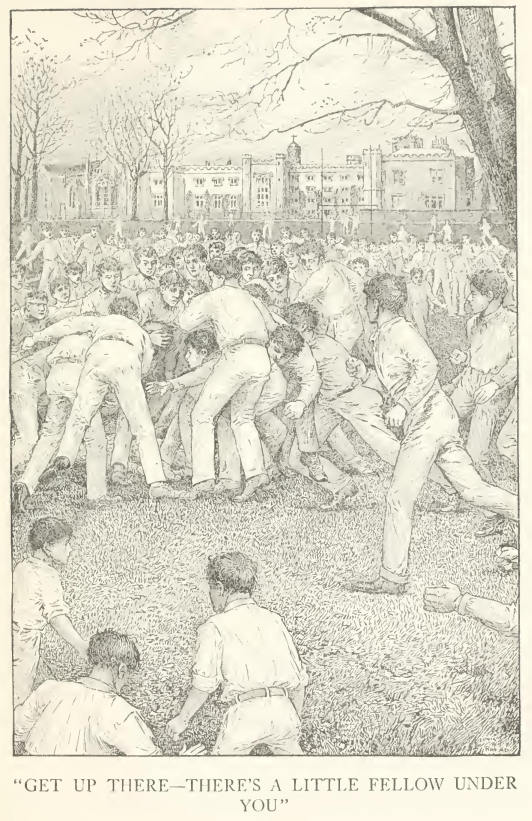
Original
Old Brooke picks him up. “Stand back, give him air,” he says; and then feeling his limbs, adds, “No bones broken.—How do you feel, young un?”
“Hah-hah!” gasps Tom, as his wind comes back; “pretty well, thank you—all right.”
“Who is he?” says Brooke.
“Oh, it's Brown; he's a new boy; I know him,” says East, coming up.
“Well, he is a plucky youngster, and will make a player,” says Brooke.
And five o'clock strikes. “No side” is called, and the first day of the School-house match is over.
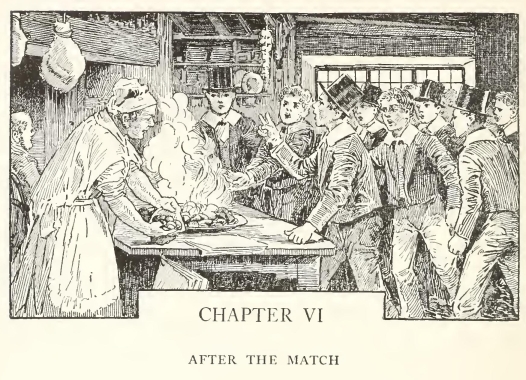
Original
CHAPTER VI—AFTER THE MATCH.
“Some food we had.”—Shakespeare. [Greek text]—Theocr. Id.
 Original
s the boys scattered away from the ground, and East, leaning on Tom's arm, and limping along, was beginning to consider what luxury they should go and buy for tea to celebrate that glorious victory, the two Brookes came striding by. Old Brooke caught sight of East, and stopped; put his hand kindly on his shoulder, and said, “Bravo, youngster; you played famously. Not much the matter, I hope?”
“No, nothing at all,” said East—“only a little twist from that charge.”
“Well, mind and get all right for next Saturday.” And the leader passed on, leaving East better for those few words than all the opodeldoc in England would have made him, and Tom ready to give one of his ears for as much notice. Ah! light words of those whom we love and honour, what a power ye are, and how carelessly wielded by those who can use you! Surely for these things also God will ask an account.
“Tea's directly after locking-up, you see,” said East, hobbling along as fast as he could, “so you come along down to Sally Harrowell's; that's our School-house tuck-shop. She bakes such stunning murphies, we'll have a penn'orth each for tea. Come along, or they'll all be gone.”
Tom's new purse and money burnt in his pocket; he wondered, as they toddled through the quadrangle and along the street, whether East would be insulted if he suggested further extravagance, as he had not sufficient faith in a pennyworth of potatoes. At last he blurted out,—
“I say, East, can't we get something else besides potatoes? I've got lots of money, you know.”
“Bless us, yes; I forgot,” said East, “you've only just come. You see all my tin's been gone this twelve weeks—it hardly ever lasts beyond the first fortnight; and our allowances were all stopped this morning for broken windows, so I haven't got a penny. I've got a tick at Sally's, of course; but then I hate running it high, you see, towards the end of the half, 'cause one has to shell out for it all directly one comes back, and that's a bore.”
Tom didn't understand much of this talk, but seized on the fact that East had no money, and was denying himself some little pet luxury in consequence. “Well, what shall I buy?” said he, “I'm uncommon hungry.”
“I say,” said East, stopping to look at him and rest his leg, “you're a trump, Brown. I'll do the same by you next half. Let's have a pound of sausages then. That's the best grub for tea I know of.”
“Very well,” said Tom, as pleased as possible; “where do they sell them?”
“Oh, over here, just opposite.” And they crossed the street and walked into the cleanest little front room of a small house, half parlour, half shop, and bought a pound of most particular sausages, East talking pleasantly to Mrs. Porter while she put them in paper, and Tom doing the paying part.
From Porter's they adjourned to Sally Harrowell's, where they found a lot of School-house boys waiting for the roast potatoes, and relating their own exploits in the day's match at the top of their voices. The street opened at once into Sally's kitchen, a low brick-floored room, with large recess for fire, and chimney-corner seats. Poor little Sally, the most good-natured and much-enduring of womankind, was bustling about, with a napkin in her hand, from her own oven to those of the neighbours' cottages up the yard at the back of the house. Stumps, her husband, a short, easy-going shoemaker, with a beery, humorous eye and ponderous calves, who lived mostly on his wife's earnings, stood in a corner of the room, exchanging shots of the roughest description of repartee with every boy in turn. “Stumps, you lout, you've had too much beer again to-day.” “'Twasn't of your paying for, then.” “Stumps's calves are running down into his ankles; they want to get to grass.” “Better be doing that than gone altogether like yours,” etc. Very poor stuff it was, but it served to make time pass; and every now and then Sally arrived in the middle with a smoking tin of potatoes, which was cleared off in a few seconds, each boy as he seized his lot running off to the house with “Put me down two-penn'orth, Sally;” “Put down three-penn'orth between me and Davis,” etc. How she ever kept the accounts so straight as she did, in her head and on her slate, was a perfect wonder.
East and Tom got served at last, and started back for the School-house, just as the locking-up bell began to ring, East on the way recounting the life and adventures of Stumps, who was a character. Amongst his other small avocations, he was the hind carrier of a sedan-chair, the last of its race, in which the Rugby ladies still went out to tea, and in which, when he was fairly harnessed and carrying a load, it was the delight of small and mischievous boys to follow him and whip his calves. This was too much for the temper even of Stumps, and he would pursue his tormentors in a vindictive and apoplectic manner when released, but was easily pacified by twopence to buy beer with.
The lower-school boys of the School-house, some fifteen in number, had tea in the lower-fifth school, and were presided over by the old verger or head-porter. Each boy had a quarter of a loaf of bread and pat of butter, and as much tea as he pleased; and there was scarcely one who didn't add to this some further luxury, such as baked potatoes, a herring, sprats, or something of the sort. But few at this period of the half-year could live up to a pound of Porter's sausages, and East was in great magnificence upon the strength of theirs. He had produced a toasting-fork from his study, and set Tom to toast the sausages, while he mounted guard over their butter and potatoes. “'Cause,” as he explained, “you're a new boy, and they'll play you some trick and get our butter; but you can toast just as well as I.” So Tom, in the midst of three or four more urchins similarly employed, toasted his face and the sausages at the same time before the huge fire, till the latter cracked; when East from his watch-tower shouted that they were done, and then the feast proceeded, and the festive cups of tea were filled and emptied, and Tom imparted of the sausages in small bits to many neighbours, and thought he had never tasted such good potatoes or seen such jolly boys. They on their parts waived all ceremony, and pegged away at the sausages and potatoes, and remembering Tom's performance in goal, voted East's new crony a brick. After tea, and while the things were being cleared away, they gathered round the fire, and the talk on the match still went on; and those who had them to show pulled up their trousers and showed the hacks they had received in the good cause.
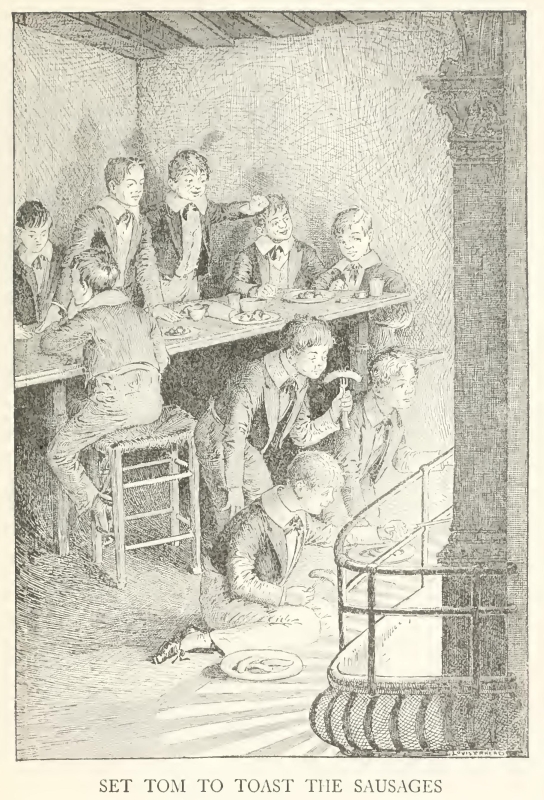
Original
They were soon, however, all turned out of the school; and East conducted Tom up to his bedroom, that he might get on clean things, and wash himself before singing.
“What's singing?” said Tom, taking his head out of his basin, where he had been plunging it in cold water.
“Well, you are jolly green,” answered his friend, from a neighbouring basin. “Why, the last six Saturdays of every half we sing of course; and this is the first of them. No first lesson to do, you know, and lie in bed to-morrow morning.”
“But who sings?”
“Why, everybody, of course; you'll see soon enough. We begin directly after supper, and sing till bed-time. It ain't such good fun now, though, as in the summer half; 'cause then we sing in the little fives court, under the library, you know. We take out tables, and the big boys sit round and drink beer—double allowance on Saturday nights; and we cut about the quadrangle between the songs, and it looks like a lot of robbers in a cave. And the louts come and pound at the great gates, and we pound back again, and shout at them. But this half we only sing in the hall. Come along down to my study.”
Their principal employment in the study was to clear out East's table; removing the drawers and ornaments and tablecloth; for he lived in the bottom passage, and his table was in requisition for the singing.
Supper came in due course at seven o'clock, consisting of bread and cheese and beer, which was all saved for the singing; and directly afterwards the fags went to work to prepare the hall. The School-house hall, as has been said, is a great long high room, with two large fires on one side, and two large iron-bound tables, one running down the middle, and the other along the wall opposite the fireplaces. Around the upper fire the fags placed the tables in the form of a horse-shoe, and upon them the jugs with the Saturday night's allowance of beer. Then the big boys used to drop in and take their seats, bringing with them bottled beer and song books; for although they all knew the songs by heart, it was the thing to have an old manuscript book descended from some departed hero, in which they were all carefully written out.
The sixth-form boys had not yet appeared; so, to fill up the gap, an interesting and time-honoured ceremony was gone through. Each new boy was placed on the table in turn, and made to sing a solo, under the penalty of drinking a large mug of salt and water if he resisted or broke down. However, the new boys all sing like nightingales to-night, and the salt water is not in requisition—Tom, as his part, performing the old west-country song of “The Leather Bottel” with considerable applause. And at the half-hour down come the sixth and fifth form boys, and take their places at the tables, which are filled up by the next biggest boys, the rest, for whom there is no room at the table, standing round outside.
The glasses and mugs are filled, and then the fugleman strikes up the old sea-song,
“A wet sheet and a flowing sea, And a wind that follows fast,” etc.,
which is the invariable first song in the School-house; and all the seventy voices join in, not mindful of harmony, but bent on noise, which they attain decidedly, but the general effect isn't bad. And then follow “The British Grenadiers,” “Billy Taylor,” “The Siege of Seringapatam,” “Three Jolly Postboys,” and other vociferous songs in rapid succession, including “The Chesapeake and Shannon,” a song lately introduced in honour of old Brooke; and when they come to the words,
“Brave Broke he waved his sword, crying, Now, my lads, aboard, And we'll stop their playing Yankee-doodle-dandy oh!”
you expect the roof to come down. The sixth and fifth know that “brave Broke” of the Shannon was no sort of relation to our old Brooke. The fourth form are uncertain in their belief, but for the most part hold that old Brooke was a midshipman then on board his uncle's ship. And the lower school never doubt for a moment that it was our old Brooke who led the boarders, in what capacity they care not a straw. During the pauses the bottled-beer corks fly rapidly, and the talk is fast and merry, and the big boys—at least all of them who have a fellow-feeling for dry throats—hand their mugs over their shoulders to be emptied by the small ones who stand round behind.
Then Warner, the head of the house, gets up and wants to speak; but he can't, for every boy knows what's coming. And the big boys who sit at the tables pound them and cheer; and the small boys who stand behind pound one another, and cheer, and rush about the hall cheering. Then silence being made, Warner reminds them of the old School-house custom of drinking the healths, on the first night of singing, of those who are going to leave at the end of the half. “He sees that they know what he is going to say already” (loud cheers), “and so won't keep them, but only ask them to treat the toast as it deserves. It is the head of the eleven, the head of big-side football, their leader on this glorious day—Pater Brooke!”
And away goes the pounding and cheering again, becoming deafening when old Brooke gets on his legs; till, a table having broken down, and a gallon or so of beer been upset, and all throats getting dry, silence ensues, and the hero speaks, leaning his hands on the table, and bending a little forwards. No action, no tricks of oratory—plain, strong, and straight, like his play.
“Gentlemen of the School-house! I am very proud of the way in which you have received my name, and I wish I could say all I should like in return. But I know I shan't. However, I'll do the best I can to say what seems to me ought to be said by a fellow who's just going to leave, and who has spent a good slice of his life here. Eight years it is, and eight such years as I can never hope to have again. So now I hope you'll all listen to me” (loud cheers of “That we will”), “for I'm going to talk seriously. You're bound to listen to me for what's the use of calling me 'pater,' and all that, if you don't mind what I say? And I'm going to talk seriously, because I feel so. It's a jolly time, too, getting to the end of the half, and a goal kicked by us first day” (tremendous applause), “after one of the hardest and fiercest day's play I can remember in eight years.” (Frantic shoutings.) “The School played splendidly, too, I will say, and kept it up to the last. That last charge of theirs would have carried away a house. I never thought to see anything again of old Crab there, except little pieces, when I saw him tumbled over by it.” (Laughter and shouting, and great slapping on the back of Jones by the boys nearest him.) “Well, but we beat 'em.” (Cheers.) “Ay, but why did we beat 'em? Answer me that.” (Shouts of “Your play.”) “Nonsense! 'Twasn't the wind and kick-off either—that wouldn't do it. 'Twasn't because we've half a dozen of the best players in the school, as we have. I wouldn't change Warner, and Hedge, and Crab, and the young un, for any six on their side.” (Violent cheers.) “But half a dozen fellows can't keep it up for two hours against two hundred. Why is it, then? I'll tell you what I think. It's because we've more reliance on one another, more of a house feeling, more fellowship than the School can have. Each of us knows and can depend on his next-hand man better. That's why we beat 'em to-day. We've union, they've division—there's the secret.” (Cheers.) “But how's this to be kept up? How's it to be improved? That's the question. For I take it we're all in earnest about beating the School, whatever else we care about. I know I'd sooner win two School-house matches running than get the Balliol scholarship any day.” (Frantic cheers.)
“Now, I'm as proud of the house as any one. I believe it's the best house in the school, out and out.” (Cheers.) “But it's a long way from what I want to see it. First, there's a deal of bullying going on. I know it well. I don't pry about and interfere; that only makes it more underhand, and encourages the small boys to come to us with their fingers in their eyes telling tales, and so we should be worse off than ever. It's very little kindness for the sixth to meddle generally—you youngsters mind that. You'll be all the better football players for learning to stand it, and to take your own parts, and fight it through. But depend on it, there's nothing breaks up a house like bullying. Bullies are cowards, and one coward makes many; so good-bye to the School-house match if bullying gets ahead here.” (Loud applause from the small boys, who look meaningly at Flashman and other boys at the tables.) “Then there's fuddling about in the public-house, and drinking bad spirits, and punch, and such rot-gut stuff. That won't make good drop-kicks or chargers of you, take my word for it. You get plenty of good beer here, and that's enough for you; and drinking isn't fine or manly, whatever some of you may think of it.
“One other thing I must have a word about. A lot of you think and say, for I've heard you, 'There's this new Doctor hasn't been here so long as some of us, and he's changing all the old customs. Rugby, and the Schoolhouse especially, are going to the dogs. Stand up for the good old ways, and down with the Doctor!' Now I'm as fond of old Rugby customs and ways as any of you, and I've been here longer than any of you, and I'll give you a word of advice in time, for I shouldn't like to see any of you getting sacked. 'Down with the Doctor's' easier said than done. You'll find him pretty tight on his perch, I take it, and an awkwardish customer to handle in that line. Besides now, what customs has he put down? There was the good old custom of taking the linchpins out of the farmers' and bagmen's gigs at the fairs, and a cowardly, blackguard custom it was. We all know what came of it, and no wonder the Doctor objected to it. But come now, any of you, name a custom that he has put down.”
“The hounds,” calls out a fifth-form boy, clad in a green cutaway with brass buttons and cord trousers, the leader of the sporting interest, and reputed a great rider and keen hand generally.
“Well, we had six or seven mangy harriers and beagles belonging to the house, I'll allow, and had had them for years, and that the Doctor put them down. But what good ever came of them? Only rows with all the keepers for ten miles round; and big-side hare-and-hounds is better fun ten times over. What else?”
No answer.
“Well, I won't go on. Think it over for yourselves. You'll find, I believe, that he don't meddle with any one that's worth keeping. And mind now, I say again, look out for squalls if you will go your own way, and that way ain't the Doctor's, for it'll lead to grief. You all know that I'm not the fellow to back a master through thick and thin. If I saw him stopping football, or cricket, or bathing, or sparring, I'd be as ready as any fellow to stand up about it. But he don't; he encourages them. Didn't you see him out to-day for half an hour watching us?” (loud cheers for the Doctor); “and he's a strong, true man, and a wise one too, and a public-school man too” (cheers), “and so let's stick to him, and talk no more rot, and drink his health as the head of the house.” (Loud cheers.) “And now I've done blowing up, and very glad I am to have done. But it's a solemn thing to be thinking of leaving a place which one has lived in and loved for eight years; and if one can say a word for the good of the old house at such a time, why, it should be said, whether bitter or sweet. If I hadn't been proud of the house and you—ay, no one knows how proud—I shouldn't be blowing you up. And now let's get to singing. But before I sit down I must give you a toast to be drunk with three-times-three and all the honours. It's a toast which I hope every one of us, wherever he may go hereafter, will never fail to drink when he thinks of the brave, bright days of his boyhood. It's a toast which should bind us all together, and to those who've gone before and who'll come after us here. It is the dear old School-house—the best house of the best school in England!”
My dear boys, old and young, you who have belonged, or do belong, to other schools and other houses, don't begin throwing my poor little book about the room, and abusing me and it, and vowing you'll read no more when you get to this point. I allow you've provocation for it. But come now—would you, any of you, give a fig for a fellow who didn't believe in and stand up for his own house and his own school? You know you wouldn't. Then don't object to me cracking up the old School house, Rugby. Haven't I a right to do it, when I'm taking all the trouble of writing this true history for all of your benefits? If you ain't satisfied, go and write the history of your own houses in your own times, and say all you know for your own schools and houses, provided it's true, and I'll read it without abusing you.
The last few words hit the audience in their weakest place. They had been not altogether enthusiastic at several parts of old Brooke's speech; but “the best house of the best school in England” was too much for them all, and carried even the sporting and drinking interests off their legs into rapturous applause, and (it is to be hoped) resolutions to lead a new life and remember old Brooke's words—which, however, they didn't altogether do, as will appear hereafter.
But it required all old Brooke's popularity to carry down parts of his speech—especially that relating to the Doctor. For there are no such bigoted holders by established forms and customs, be they never so foolish or meaningless, as English school-boys—at least, as the school-boys of our generation. We magnified into heroes every boy who had left, and looked upon him with awe and reverence when he revisited the place a year or so afterwards, on his way to or from Oxford or Cambridge; and happy was the boy who remembered him, and sure of an audience as he expounded what he used to do and say, though it were sad enough stuff to make angels, not to say head-masters, weep.
We looked upon every trumpery little custom and habit which had obtained in the School as though it had been a law of the Medes and Persians, and regarded the infringement or variation of it as a sort of sacrilege. And the Doctor, than whom no man or boy had a stronger liking for old school customs which were good and sensible, had, as has already been hinted, come into most decided collision with several which were neither the one nor the other. And as old Brooke had said, when he came into collision with boys or customs, there was nothing for them but to give in or take themselves off; because what he said had to be done, and no mistake about it. And this was beginning to be pretty clearly understood. The boys felt that there was a strong man over them, who would have things his own way, and hadn't yet learnt that he was a wise and loving man also. His personal character and influence had not had time to make itself felt, except by a very few of the bigger boys with whom he came more directly into contact; and he was looked upon with great fear and dislike by the great majority even of his own house. For he had found School and School-house in a state of monstrous license and misrule, and was still employed in the necessary but unpopular work of setting up order with a strong hand.
However, as has been said, old Brooke triumphed, and the boys cheered him and then the Doctor. And then more songs came, and the healths of the other boys about to leave, who each made a speech, one flowery, another maudlin, a third prosy, and so on, which are not necessary to be here recorded.
Half-past nine struck in the middle of the performance of “Auld Lang Syne,” a most obstreperous proceeding, during which there was an immense amount of standing with one foot on the table, knocking mugs together and shaking hands, without which accompaniments it seems impossible for the youths of Britain to take part in that famous old song. The under-porter of the School-house entered during the performance, bearing five or six long wooden candlesticks with lighted dips in them, which he proceeded to stick into their holes in such part of the great tables as he could get at; and then stood outside the ring till the end of the song, when he was hailed with shouts.
“Bill you old muff, the half-hour hasn't struck.” “Here, Bill, drink some cocktail.” “Sing us a song, old boy.” “Don't you wish you may get the table?” Bill drank the proffered cocktail not unwillingly, and putting down the empty glass, remonstrated. “Now gentlemen, there's only ten minutes to prayers, and we must get the hall straight.”
Shouts of “No, no!” and a violent effort to strike up “Billy Taylor” for the third time. Bill looked appealingly to old Brooke, who got up and stopped the noise. “Now then, lend a hand, you youngsters, and get the tables back; clear away the jugs and glasses. Bill's right. Open the windows, Warner.” The boy addressed, who sat by the long ropes, proceeded to pull up the great windows, and let in a clear, fresh rush of night air, which made the candles flicker and gutter, and the fires roar. The circle broke up, each collaring his own jug, glass, and song-book; Bill pounced on the big table, and began to rattle it away to its place outside the buttery door. The lower-passage boys carried off their small tables, aided by their friends; while above all, standing on the great hall-table, a knot of untiring sons of harmony made night doleful by a prolonged performance of “God Save the King.” His Majesty King William the Fourth then reigned over us, a monarch deservedly popular amongst the boys addicted to melody, to whom he was chiefly known from the beginning of that excellent if slightly vulgar song in which they much delighted,—
“Come, neighbours all, both great and small, Perform your duties here, And loudly sing, 'Live Billy, our king,' For bating the tax upon beer.”
Others of the more learned in songs also celebrated his praises in a sort of ballad, which I take to have been written by some Irish loyalist. I have forgotten all but the chorus, which ran,—
“God save our good King William, Be his name for ever blest; He's the father of all his people, And the guardian of all the rest.”
In troth we were loyal subjects in those days, in a rough way. I trust that our successors make as much of her present Majesty, and, having regard to the greater refinement of the times, have adopted or written other songs equally hearty, but more civilized, in her honour.
Then the quarter to ten struck, and the prayer-bell rang. The sixth and fifth form boys ranged themselves in their school order along the wall, on either side of the great fires, the middle-fifth and upper-school boys round the long table in the middle of the hall, and the lower-school boys round the upper part of the second long table, which ran down the side of the hall farthest from the fires. Here Tom found himself at the bottom of all, in a state of mind and body not at all fit for prayers, as he thought; and so tried hard to make himself serious, but couldn't, for the life of him, do anything but repeat in his head the choruses of some of the songs, and stare at all the boys opposite, wondering at the brilliancy of their waistcoats, and speculating what sort of fellows they were. The steps of the head-porter are heard on the stairs, and a light gleams at the door. “Hush!” from the fifth-form boys who stand there, and then in strides the Doctor, cap on head, book in one hand, and gathering up his gown in the other. He walks up the middle, and takes his post by Warner, who begins calling over the names. The Doctor takes no notice of anything, but quietly turns over his book and finds the place, and then stands, cap in hand and finger in book, looking straight before his nose. He knows better than any one when to look, and when to see nothing. To-night is singing night, and there's been lots of noise and no harm done—nothing but beer drunk, and nobody the worse for it, though some of them do look hot and excited. So the Doctor sees nothing, but fascinates Tom in a horrible manner as he stands there, and reads out the psalm, in that deep, ringing, searching voice of his. Prayers are over, and Tom still stares open-mouthed after the Doctor's retiring figure, when he feels a pull at his sleeve, and turning round, sees East.
“I say, were you ever tossed in a blanket?”
“No,” said Tom; “why?”
“'Cause there'll be tossing to-night, most likely, before the sixth come up to bed. So if you funk, you just come along and hide, or else they'll catch you and toss you.”
“Were you ever tossed? Does it hurt?” inquired Tom.
“Oh yes, bless you, a dozen times,” said East, as he hobbled along by Tom's side upstairs. “It don't hurt unless you fall on the floor. But most fellows don't like it.”
They stopped at the fireplace in the top passage, where were a crowd of small boys whispering together, and evidently unwilling to go up into the bedrooms. In a minute, however, a study door opened, and a sixth-form boy came out, and off they all scuttled up the stairs, and then noiselessly dispersed to their different rooms. Tom's heart beat rather quick as he and East reached their room, but he had made up his mind. “I shan't hide, East,” said he.
“Very well, old fellow,” replied East, evidently pleased; “no more shall I. They'll be here for us directly.”
The room was a great big one, with a dozen beds in it, but not a boy that Tom could see except East and himself. East pulled off his coat and waistcoat, and then sat on the bottom of his bed whistling and pulling off his boots. Tom followed his example.
A noise and steps are heard in the passage, the door opens, and in rush four or five great fifth-form boys, headed by Flashman in his glory.
Tom and East slept in the farther corner of the room, and were not seen at first.
“Gone to ground, eh?” roared Flashman. “Push 'em out then, boys; look under the beds.” And he pulled up the little white curtain of the one nearest him. “Who-o-op!” he roared, pulling away at the leg of a small boy, who held on tight to the leg of the bed, and sang out lustily for mercy.
“Here, lend a hand, one of you, and help me pull out this young howling brute.—Hold your tongue, sir, or I'll kill you.”
“Oh, please, Flashman, please, Walker, don't toss me! I'll fag for you—I'll do anything—only don't toss me.”
“You be hanged,” said Flashman, lugging the wretched boy along; “'twon't hurt you,—you!—Come along, boys; here he is.”
“I say, Flashey,” sang out another of the big boys; “drop that; you heard what old Pater Brooke said to-night. I'll be hanged if we'll toss any one against their will. No more bullying. Let him go, I say.”
Flashman, with an oath and a kick, released his prey, who rushed headlong under his bed again, for fear they should change their minds, and crept along underneath the other beds, till he got under that of the sixth-form boy, which he knew they daren't disturb.
“There's plenty of youngsters don't care about it,” said Walker. “Here, here's Scud East—you'll be tossed, won't you, young un?” Scud was East's nickname, or Black, as we called it, gained by his fleetness of foot.
“Yes,” said East, “if you like, only mind my foot.”
“And here's another who didn't hide.—Hullo! new boy; what's your name, sir?”
“Brown.”
“Well, Whitey Brown, you don't mind being tossed?”
“No,” said Tom, setting his teeth.
“Come along then, boys,” sang out Walker; and away they all went, carrying along Tom and East, to the intense relief of four or five other small boys, who crept out from under the beds and behind them.
“What a trump Scud is!” said one. “They won't come back here now.”
“And that new boy, too; he must be a good-plucked one.”
“Ah! wait till he has been tossed on to the floor; see how he'll like it then!”
Meantime the procession went down the passage to Number 7, the largest room, and the scene of the tossing, in the middle of which was a great open space. Here they joined other parties of the bigger boys, each with a captive or two, some willing to be tossed, some sullen, and some frightened to death. At Walker's suggestion all who were afraid were let off, in honour of Pater Brooke's speech.
Then a dozen big boys seized hold of a blanket, dragged from one of the beds. “In with Scud; quick! there's no time to lose.” East was chucked into the blanket. “Once, twice, thrice, and away!” Up he went like a shuttlecock, but not quite up to the ceiling.
“Now, boys, with a will,” cried Walker; “once, twice, thrice, and away!” This time he went clean up, and kept himself from touching the ceiling with his hand, and so again a third time, when he was turned out, and up went another boy. And then came Tom's turn. He lay quite still, by East's advice, and didn't dislike the “once, twice, thrice;” but the “away” wasn't so pleasant. They were in good wind now, and sent him slap up to the ceiling first time, against which his knees came rather sharply. But the moment's pause before descending was the rub—the feeling of utter helplessness and of leaving his whole inside behind him sticking to the ceiling. Tom was very near shouting to be set down when he found himself back in the blanket, but thought of East, and didn't; and so took his three tosses without a kick or a cry, and was called a young trump for his pains.
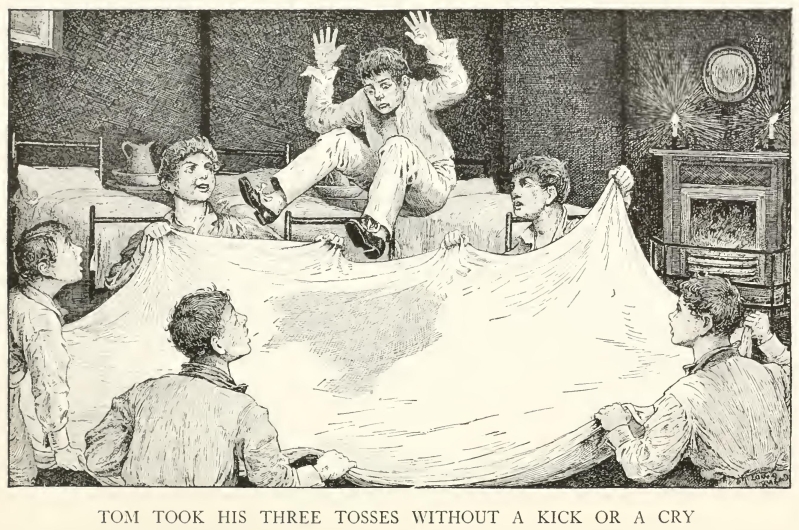
Original
He and East, having earned it, stood now looking on. No catastrophe happened, as all the captives were cool hands, and didn't struggle. This didn't suit Flashman. What your real bully likes in tossing is when the boys kick and struggle, or hold on to one side of the blanket, and so get pitched bodily on to the floor; it's no fun to him when no one is hurt or frightened.
“Let's toss two of them together, Walker,” suggested he.
“What a cursed bully you are, Flashey!” rejoined the other. “Up with another one.”
And so now two boys were tossed together, the peculiar hardship of which is, that it's too much for human nature to lie still then and share troubles; and so the wretched pair of small boys struggle in the air which shall fall a-top in the descent, to the no small risk of both falling out of the blanket, and the huge delight of brutes like Flashman.
But now there's a cry that the praepostor of the room is coming; so the tossing stops, and all scatter to their different rooms; and Tom is left to turn in, with the first day's experience of a public school to meditate upon.
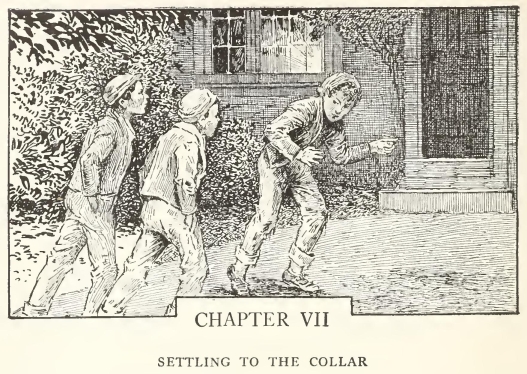
Original
CHAPTER VII—SETTLING TO THE COLLAR.
“Says Giles, ''Tis mortal hard to go, But if so be's I must I means to follow arter he As goes hisself the fust.'”—Ballad.
 Original
verybody, I suppose, knows the dreamy, delicious state in which one lies, half asleep, half awake, while consciousness begins to return after a sound night's rest in a new place which we are glad to be in, following upon a day of unwonted excitement and exertion. There are few pleasanter pieces of life. The worst of it is that they last such a short time; for nurse them as you will, by lying perfectly passive in mind and body, you can't make more than five minutes or so of them. After which time the stupid, obtrusive, wakeful entity which we call “I”, as impatient as he is stiff-necked, spite of our teeth will force himself back again, and take possession of us down to our very toes.
It was in this state that Master Tom lay at half-past seven on the morning following the day of his arrival, and from his clean little white bed watched the movements of Bogle (the generic name by which the successive shoeblacks of the School-house were known), as he marched round from bed to bed, collecting the dirty shoes and boots, and depositing clean ones in their places.
There he lay, half doubtful as to where exactly in the universe he was, but conscious that he had made a step in life which he had been anxious to make. It was only just light as he looked lazily out of the wide windows, and saw the tops of the great elms, and the rooks circling about and cawing remonstrances to the lazy ones of their commonwealth before starting in a body for the neighbouring ploughed fields. The noise of the room-door closing behind Bogle, as he made his exit with the shoebasket under his arm, roused him thoroughly, and he sat up in bed and looked round the room. What in the world could be the matter with his shoulders and loins? He felt as if he had been severely beaten all down his back—the natural results of his performance at his first match. He drew up his knees and rested his chin on them, and went over all the events of yesterday, rejoicing in his new life, what he had seen of it, and all that was to come.
Presently one or two of the other boys roused themselves, and began to sit up and talk to one another in low tones. Then East, after a roll or two, came to an anchor also, and nodding to Tom, began examining his ankle.
“What a pull,” said he, “that it's lie-in-bed, for I shall be as lame as a tree, I think.”
It was Sunday morning, and Sunday lectures had not yet been established; so that nothing but breakfast intervened between bed and eleven o'clock chapel—a gap by no means easy to fill up: in fact, though received with the correct amount of grumbling, the first lecture instituted by the Doctor shortly afterwards was a great boon to the School. It was lie-in-bed, and no one was in a hurry to get up, especially in rooms where the sixth-form boy was a good-tempered fellow, as was the case in Tom's room, and allowed the small boys to talk and laugh and do pretty much what they pleased, so long as they didn't disturb him. His bed was a bigger one than the rest, standing in the corner by the fireplace, with a washing-stand and large basin by the side, where he lay in state with his white curtains tucked in so as to form a retiring place—an awful subject of contemplation to Tom, who slept nearly opposite, and watched the great man rouse himself and take a book from under his pillow, and begin reading, leaning his head on his hand, and turning his back to the room. Soon, however, a noise of striving urchins arose, and muttered encouragements from the neighbouring boys of “Go it, Tadpole!” “Now, young Green!” “Haul away his blanket!” “Slipper him on the hands!” Young Green and little Hall, commonly called Tadpole, from his great black head and thin legs, slept side by side far away by the door, and were for ever playing one another tricks, which usually ended, as on this morning, in open and violent collision; and now, unmindful of all order and authority, there they were, each hauling away at the other's bedclothes with one hand, and with the other, armed with a slipper, belabouring whatever portion of the body of his adversary came within reach.
“Hold that noise up in the corner,” called out the praepostor, sitting up and looking round his curtains; and the Tadpole and young Green sank down into their disordered beds; and then, looking at his watch, added, “Hullo! past eight. Whose turn for hot water?”
(Where the praepostor was particular in his ablutions, the fags in his room had to descend in turn to the kitchen, and beg or steal hot water for him; and often the custom extended farther, and two boys went down every morning to get a supply for the whole room.)
“East's and Tadpole's,” answered the senior fag, who kept the rota.
“I can't go,” said East; “I'm dead lame.”
“Well, be quick some of you, that's all,” said the great man, as he turned out of bed, and putting on his slippers, went out into the great passage, which runs the whole length of the bedrooms, to get his Sunday habiliments out of his portmanteau.
“Let me go for you,” said Tom to East; “I should like it.”
“Well, thank 'ee, that's a good fellow. Just pull on your trousers, and take your jug and mine. Tadpole will show you the way.”
And so Tom and the Tadpole, in nightshirts and trousers, started off downstairs, and through “Thos's hole,” as the little buttery, where candles and beer and bread and cheese were served out at night, was called, across the School-house court, down a long passage, and into the kitchen; where, after some parley with the stalwart, handsome cook, who declared that she had filled a dozen jugs already, they got their hot water, and returned with all speed and great caution. As it was, they narrowly escaped capture by some privateers from the fifth-form rooms, who were on the lookout for the hot-water convoys, and pursued them up to the very door of their room, making them spill half their load in the passage.
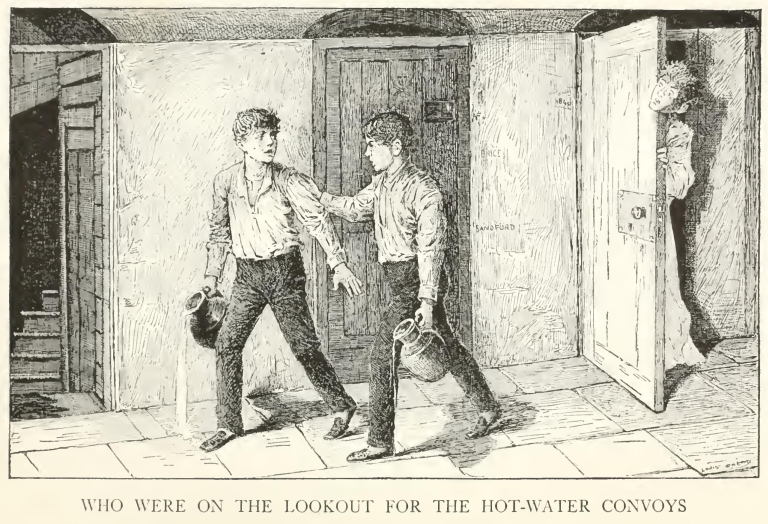
Original
“Better than going down again though,” as Tadpole remarked, “as we should have had to do if those beggars had caught us.”
By the time that the calling-over bell rang, Tom and his new comrades were all down, dressed in their best clothes, and he had the satisfaction of answering “here” to his name for the first time, the praepostor of the week having put it in at the bottom of his list. And then came breakfast and a saunter about the close and town with East, whose lameness only became severe when any fagging had to be done. And so they whiled away the time until morning chapel.
It was a fine November morning, and the close soon became alive with boys of all ages, who sauntered about on the grass, or walked round the gravel walk, in parties of two or three. East, still doing the cicerone, pointed out all the remarkable characters to Tom as they passed: Osbert, who could throw a cricket-ball from the little-side ground over the rook-trees to the Doctor's wall; Gray, who had got the Balliol scholarship, and, what East evidently thought of much more importance, a half-holiday for the School by his success; Thorne, who had run ten miles in two minutes over the hour; Black, who had held his own against the cock of the town in the last row with the louts; and many more heroes, who then and there walked about and were worshipped, all trace of whom has long since vanished from the scene of their fame. And the fourth-form boy who reads their names rudely cut on the old hall tables, or painted upon the big-side cupboard (if hall tables and big-side cupboards still exist), wonders what manner of boys they were. It will be the same with you who wonder, my sons, whatever your prowess may be in cricket, or scholarship, or football. Two or three years, more or less, and then the steadily advancing, blessed wave will pass over your names as it has passed over ours. Nevertheless, play your games and do your work manfully—see only that that be done—and let the remembrance of it take care of itself.
The chapel-bell began to ring at a quarter to eleven, and Tom got in early and took his place in the lowest row, and watched all the other boys come in and take their places, filling row after row; and tried to construe the Greek text which was inscribed over the door with the slightest possible success, and wondered which of the masters, who walked down the chapel and took their seats in the exalted boxes at the end, would be his lord. And then came the closing of the doors, and the Doctor in his robes, and the service, which, however, didn't impress him much, for his feeling of wonder and curiosity was too strong. And the boy on one side of him was scratching his name on the oak panelling in front, and he couldn't help watching to see what the name was, and whether it was well scratched; and the boy on the other side went to sleep, and kept falling against him; and on the whole, though many boys even in that part of the school were serious and attentive, the general atmosphere was by no means devotional; and when he got out into the close again, he didn't feel at all comfortable, or as if he had been to church.
But at afternoon chapel it was quite another thing. He had spent the time after dinner in writing home to his mother, and so was in a better frame of mind; and his first curiosity was over, and he could attend more to the service. As the hymn after the prayers was being sung, and the chapel was getting a little dark, he was beginning to feel that he had been really worshipping. And then came that great event in his, as in every Rugby boy's life of that day—the first sermon from the Doctor.
More worthy pens than mine have described that scene—the oak pulpit standing out by itself above the School seats; the tall, gallant form, the kindling eye, the voice, now soft as the low notes of a flute, now clear and stirring as the call of the light-infantry bugle, of him who stood there Sunday after Sunday, witnessing and pleading for his Lord, the King of righteousness and love and glory, with whose Spirit he was filled, and in whose power he spoke; the long lines of young faces, rising tier above tier down the whole length of the chapel, from the little boy's who had just left his mother to the young man's who was going out next week into the great world, rejoicing in his strength. It was a great and solemn sight, and never more so than at this time of year, when the only lights in the chapel were in the pulpit and at the seats of the praepostors of the week, and the soft twilight stole over the rest of the chapel, deepening into darkness in the high gallery behind the organ.
But what was it, after all, which seized and held these three hundred boys, dragging them out of themselves, willing or unwilling, for twenty minutes, on Sunday afternoons? True, there always were boys scattered up and down the School, who in heart and head were worthy to hear and able to carry away the deepest and wisest words there spoken. But these were a minority always, generally a very small one, often so small a one as to be countable on the fingers of your hand. What was it that moved and held us, the rest of the three hundred reckless, childish boys, who feared the Doctor with all our hearts, and very little besides in heaven or earth; who thought more of our sets in the School than of the Church of Christ, and put the traditions of Rugby and the public opinion of boys in our daily life above the laws of God? We couldn't enter into half that we heard; we hadn't the knowledge of our own hearts or the knowledge of one another, and little enough of the faith, hope, and love needed to that end. But we listened, as all boys in their better moods will listen (ay, and men too for the matter of that), to a man whom we felt to be, with all his heart and soul and strength, striving against whatever was mean and unmanly and unrighteous in our little world. It was not the cold, clear voice of one giving advice and warning from serene heights to those who were struggling and sinning below, but the warm, living voice of one who was fighting for us and by our sides, and calling on us to help him and ourselves and one another. And so, wearily and little by little, but surely and steadily on the whole, was brought home to the young boy, for the first time, the meaning of his life—that it was no fool's or sluggard's paradise into which he had wandered by chance, but a battlefield ordained from of old, where there are no spectators, but the youngest must take his side, and the stakes are life and death. And he who roused this consciousness in them showed them at the same time, by every word he spoke in the pulpit, and by his whole daily life, how that battle was to be fought, and stood there before them their fellow-soldier and the captain of their band—the true sort of captain, too, for a boy's army—one who had no misgivings, and gave no uncertain word of command, and, let who would yield or make truce, would fight the fight out (so every boy felt) to the last gasp and the last drop of blood. Other sides of his character might take hold of and influence boys here and there; but it was this thoroughness and undaunted courage which, more than anything else, won his way to the hearts of the great mass of those on whom he left his mark, and made them believe first in him and then in his Master.
It was this quality above all others which moved such boys as our hero, who had nothing whatever remarkable about him except excess of boyishness—by which I mean animal life in its fullest measure, good nature and honest impulses, hatred of injustice and meanness, and thoughtlessness enough to sink a three-decker. And so, during the next two years, in which it was more than doubtful whether he would get good or evil from the School, and before any steady purpose or principle grew up in him, whatever his week's sins and shortcomings might have been, he hardly ever left the chapel on Sunday evenings without a serious resolve to stand by and follow the Doctor, and a feeling that it was only cowardice (the incarnation of all other sins in such a boy's mind) which hindered him from doing so with all his heart.
The next day Tom was duly placed in the third form, and began his lessons in a corner of the big School. He found the work very easy, as he had been well grounded, and knew his grammar by heart; and, as he had no intimate companions to make him idle (East and his other School-house friends being in the lower fourth, the form above him), soon gained golden opinions from his master, who said he was placed too low, and should be put out at the end of the half-year. So all went well with him in School, and he wrote the most flourishing letters home to his mother, full of his own success and the unspeakable delights of a public school.
In the house, too, all went well. The end of the half-year was drawing near, which kept everybody in a good humour, and the house was ruled well and strongly by Warner and Brooke. True, the general system was rough and hard, and there was bullying in nooks and corners—bad signs for the future; but it never got farther, or dared show itself openly, stalking about the passages and hall and bedrooms, and making the life of the small boys a continual fear.
Tom, as a new boy, was of right excused fagging for the first month, but in his enthusiasm for his new life this privilege hardly pleased him; and East and others of his young friends, discovering this, kindly allowed him to indulge his fancy, and take their turns at night fagging and cleaning studies. These were the principal duties of the fags in the house. From supper until nine o'clock three fags taken in order stood in the passages, and answered any praepostor who called “Fag,” racing to the door, the last comer having to do the work. This consisted generally of going to the buttery for beer and bread and cheese (for the great men did not sup with the rest, but had each his own allowance in his study or the fifth-form room), cleaning candlesticks and putting in new candles, toasting cheese, bottling beer, and carrying messages about the house; and Tom, in the first blush of his hero-worship, felt it a high privilege to receive orders from and be the bearer of the supper of old Brooke. And besides this night-work, each praepostor had three or four fags specially allotted to him, of whom he was supposed to be the guide, philosopher, and friend, and who in return for these good offices had to clean out his study every morning by turns, directly after first lesson and before he returned from breakfast. And the pleasure of seeing the great men's studies, and looking at their pictures, and peeping into their books, made Tom a ready substitute for any boy who was too lazy to do his own work. And so he soon gained the character of a good-natured, willing fellow, who was ready to do a turn for any one.
In all the games, too, he joined with all his heart, and soon became well versed in all the mysteries of football, by continual practice at the School-house little-side, which played daily.
The only incident worth recording here, however, was his first run at hare-and-hounds. On the last Tuesday but one of the half-year he was passing through the hall after dinner, when he was hailed with shouts from Tadpole and several other fags seated at one of the long tables, the chorus of which was, “Come and help us tear up scent.”
Tom approached the table in obedience to the mysterious summons, always ready to help, and found the party engaged in tearing up old newspapers, copy-books, and magazines, into small pieces, with which they were filling four large canvas bags.
“It's the turn of our house to find scent for big-side hare-and-hounds,” exclaimed Tadpole. “Tear away; there's no time to lose before calling-over.”
“I think it's a great shame,” said another small boy, “to have such a hard run for the last day.”
“Which run is it?” said Tadpole.
“Oh, the Barby run, I hear,” answered the other; “nine miles at least, and hard ground; no chance of getting in at the finish, unless you're a first-rate scud.”
“Well, I'm going to have a try,” said Tadpole; “it's the last run of the half, and if a fellow gets in at the end big-side stands ale and bread and cheese and a bowl of punch; and the Cock's such a famous place for ale.”
“I should like to try too,” said Tom.
“Well, then, leave your waistcoat behind, and listen at the door, after calling-over, and you'll hear where the meet is.”
After calling-over, sure enough there were two boys at the door, calling out, “Big-side hare-and-hounds meet at White Hall;” and Tom, having girded himself with leather strap, and left all superfluous clothing behind, set off for White Hall, an old gable-ended house some quarter of a mile from the town, with East, whom he had persuaded to join, notwithstanding his prophecy that they could never get in, as it was the hardest run of the year.
At the meet they found some forty or fifty boys, and Tom felt sure, from having seen many of them run at football, that he and East were more likely to get in than they.
After a few minutes' waiting, two well-known runners, chosen for the hares, buckled on the four bags filled with scent, compared their watches with those of young Brooke and Thorne, and started off at a long, slinging trot across the fields in the direction of Barby.
Then the hounds clustered round Thorne, who explained shortly, “They're to have six minutes' law. We run into the Cock, and every one who comes in within a quarter of an hour of the hares'll be counted, if he has been round Barby church.” Then came a minute's pause or so, and then the watches are pocketed, and the pack is led through the gateway into the field which the hares had first crossed. Here they break into a trot, scattering over the field to find the first traces of the scent which the hares throw out as they go along. The old hounds make straight for the likely points, and in a minute a cry of “Forward” comes from one of them, and the whole pack, quickening their pace, make for the spot, while the boy who hit the scent first, and the two or three nearest to him, are over the first fence, and making play along the hedgerow in the long grass-field beyond. The rest of the pack rush at the gap already made, and scramble through, jostling one another. “Forward” again, before they are half through. The pace quickens into a sharp run, the tail hounds all straining to get up to the lucky leaders. They are gallant hares, and the scent lies thick right across another meadow and into a ploughed field, where the pace begins to tell; then over a good wattle with a ditch on the other side, and down a large pasture studded with old thorns, which slopes down to the first brook. The great Leicestershire sheep charge away across the field as the pack comes racing down the slope. The brook is a small one, and the scent lies right ahead up the opposite slope, and as thick as ever—not a turn or a check to favour the tail hounds, who strain on, now trailing in a long line, many a youngster beginning to drag his legs heavily, and feel his heart beat like a hammer, and the bad-plucked ones thinking that after all it isn't worth while to keep it up.
Tom, East, and the Tadpole had a good start, and are well up for such young hands, and after rising the slope and crossing the next field, find themselves up with the leading hounds, who have overrun the scent, and are trying back. They have come a mile and a half in about eleven minutes, a pace which shows that it is the last day. About twenty-five of the original starters only show here, the rest having already given in; the leaders are busy making casts into the fields on the left and right, and the others get their second winds.
Then comes the cry of “Forward” again from young Brooke, from the extreme left, and the pack settles down to work again steadily and doggedly, the whole keeping pretty well together. The scent, though still good, is not so thick; there is no need of that, for in this part of the run every one knows the line which must be taken, and so there are no casts to be made, but good downright running and fencing to be done. All who are now up mean coming in, and they come to the foot of Barby Hill without losing more than two or three more of the pack. This last straight two miles and a half is always a vantage ground for the hounds, and the hares know it well; they are generally viewed on the side of Barby Hill, and all eyes are on the lookout for them to-day. But not a sign of them appears, so now will be the hard work for the hounds, and there is nothing for it but to cast about for the scent, for it is now the hares' turn, and they may baffle the pack dreadfully in the next two miles.
Ill fares it now with our youngsters, that they are School-house boys, and so follow young Brooke, for he takes the wide casts round to the left, conscious of his own powers, and loving the hard work. For if you would consider for a moment, you small boys, you would remember that the Cock, where the run ends and the good ale will be going, lies far out to the right on the Dunchurch road, so that every cast you take to the left is so much extra work. And at this stage of the run, when the evening is closing in already, no one remarks whether you run a little cunning or not; so you should stick to those crafty hounds who keep edging away to the right, and not follow a prodigal like young Brooke, whose legs are twice as long as yours and of cast-iron, wholly indifferent to one or two miles more or less. However, they struggle after him, sobbing and plunging along, Tom and East pretty close, and Tadpole, whose big head begins to pull him down, some thirty yards behind.
Now comes a brook, with stiff clay banks, from which they can hardly drag their legs, and they hear faint cries for help from the wretched Tadpole, who has fairly stuck fast. But they have too little run left in themselves to pull up for their own brothers. Three fields more, and another check, and then “Forward” called away to the extreme right.
The two boys' souls die within them; they can never do it. Young Brooke thinks so too, and says kindly, “You'll cross a lane after next field; keep down it, and you'll hit the Dunchurch road below the Cock,” and then steams away for the run in, in which he's sure to be first, as if he were just starting. They struggle on across the next field, the “forwards” getting fainter and fainter, and then ceasing. The whole hunt is out of ear-shot, and all hope of coming in is over.
“Hang it all!” broke out East, as soon as he had got wind enough, pulling off his hat and mopping at his face, all spattered with dirt and lined with sweat, from which went up a thick steam into the still, cold air. “I told you how it would be. What a thick I was to come! Here we are, dead beat, and yet I know we're close to the run in, if we knew the country.”
“Well,” said Tom, mopping away, and gulping down his disappointment, “it can't be helped. We did our best anyhow. Hadn't we better find this lane, and go down it, as young Brooke told us?”
“I suppose so—nothing else for it,” grunted East. “If ever I go out last day again.” Growl, growl, growl.
So they tried back slowly and sorrowfully, and found the lane, and went limping down it, plashing in the cold puddly ruts, and beginning to feel how the run had taken it out of them. The evening closed in fast, and clouded over, dark, cold, and dreary.
“I say, it must be locking-up, I should think,” remarked East, breaking the silence—“it's so dark.”
“What if we're late?” said Tom.
“No tea, and sent up to the Doctor,” answered East.
The thought didn't add to their cheerfulness. Presently a faint halloo was heard from an adjoining field. They answered it and stopped, hoping for some competent rustic to guide them, when over a gate some twenty yards ahead crawled the wretched Tadpole, in a state of collapse. He had lost a shoe in the brook, and had been groping after it up to his elbows in the stiff, wet clay, and a more miserable creature in the shape of boy seldom has been seen.
The sight of him, notwithstanding, cheered them, for he was some degrees more wretched than they. They also cheered him, as he was no longer under the dread of passing his night alone in the fields. And so, in better heart, the three plashed painfully down the never-ending lane. At last it widened, just as utter darkness set in, and they came out on a turnpike road, and there paused, bewildered, for they had lost all bearings, and knew not whether to turn to the right or left.
Luckily for them they had not to decide, for lumbering along the road, with one lamp lighted and two spavined horses in the shafts, came a heavy coach, which after a moment's suspense they recognized as the Oxford coach, the redoubtable Pig and Whistle.
It lumbered slowly up, and the boys, mustering their last run, caught it as it passed, and began clambering up behind, in which exploit East missed his footing and fell flat on his nose along the road. Then the others hailed the old scarecrow of a coachman, who pulled up and agreed to take them in for a shilling; so there they sat on the back seat, drubbing with their heels, and their teeth chattering with cold, and jogged into Rugby some forty minutes after locking-up.
Five minutes afterwards three small, limping, shivering figures steal along through the Doctor's garden, and into the house by the servants' entrance (all the other gates have been closed long since), where the first thing they light upon in the passage is old Thomas, ambling along, candle in one hand and keys in the other.
He stops and examines their condition with a grim smile. “Ah! East, Hall, and Brown, late for locking-up. Must go up to the Doctor's study at once.”
“Well but, Thomas, mayn't we go and wash first? You can put down the time, you know.”
“Doctor's study d'rectly you come in—that's the orders,” replied old Thomas, motioning towards the stairs at the end of the passage which led up into the Doctor's house; and the boys turned ruefully down it, not cheered by the old verger's muttered remark, “What a pickle they boys be in!” Thomas referred to their faces and habiliments, but they construed it as indicating the Doctor's state of mind. Upon the short flight of stairs they paused to hold counsel.
“Who'll go in first?” inquires Tadpole.
“You—you're the senior,” answered East.
“Catch me. Look at the state I'm in,” rejoined Hall, showing the arms of his jacket. “I must get behind you two.”
“Well, but look at me,” said East, indicating the mass of clay behind which he was standing; “I'm worse than you, two to one. You might grow cabbages on my trousers.”
“That's all down below, and you can keep your legs behind the sofa,” said Hall.
“Here, Brown; you're the show-figure. You must lead.”
“But my face is all muddy,” argued Tom.
“Oh, we're all in one boat for that matter; but come on; we're only making it worse, dawdling here.”
“Well, just give us a brush then,” said Tom. And they began trying to rub off the superfluous dirt from each other's jackets; but it was not dry enough, and the rubbing made them worse; so in despair they pushed through the swing-door at the head of the stairs, and found themselves in the Doctor's hall.
“That's the library door,” said East in a whisper, pushing Tom forwards. The sound of merry voices and laughter came from within, and his first hesitating knock was unanswered. But at the second, the Doctor's voice said, “Come in;” and Tom turned the handle, and he, with the others behind him, sidled into the room.
The Doctor looked up from his task; he was working away with a great chisel at the bottom of a boy's sailing boat, the lines of which he was no doubt fashioning on the model of one of Nicias's galleys. Round him stood three or four children; the candles burnt brightly on a large table at the farther end, covered with books and papers, and a great fire threw a ruddy glow over the rest of the room. All looked so kindly, and homely, and comfortable that the boys took heart in a moment, and Tom advanced from behind the shelter of the great sofa. The Doctor nodded to the children, who went out, casting curious and amused glances at the three young scarecrows.
“Well, my little fellows,” began the Doctor, drawing himself up with his back to the fire, the chisel in one hand and his coat-tails in the other, and his eyes twinkling as he looked them over; “what makes you so late?”
“Please, sir, we've been out big-side hare-and-hounds, and lost our way.”
“Hah! you couldn't keep up, I suppose?”
“Well, sir,” said East, stepping out, and not liking that the Doctor should think lightly of his running powers, “we got round Barby all right; but then—”
“Why, what a state you're in, my boy!” interrupted the Doctor, as the pitiful condition of East's garments was fully revealed to him.
“That's the fall I got, sir, in the road,” said East, looking down at himself; “the Old Pig came by—”
“The what?” said the Doctor.
“The Oxford coach, sir,” explained Hall.
“Hah! yes, the Regulator,” said the Doctor.
“And I tumbled on my face, trying to get up behind,” went on East.
“You're not hurt, I hope?” said the Doctor.
“Oh no, sir.”
“Well now, run upstairs, all three of you, and get clean things on, and then tell the housekeeper to give you some tea. You're too young to try such long runs. Let Warner know I've seen you. Good-night.”
“Good-night, sir.” And away scuttled the three boys in high glee.
“What a brick, not to give us even twenty lines to learn!” said the Tadpole, as they reached their bedroom; and in half an hour afterwards they were sitting by the fire in the housekeeper's room at a sumptuous tea, with cold meat—“Twice as good a grub as we should have got in the hall,” as the Tadpole remarked with a grin, his mouth full of buttered toast. All their grievances were forgotten, and they were resolving to go out the first big-side next half, and thinking hare-and-hounds the most delightful of games.
A day or two afterwards the great passage outside the bedrooms was cleared of the boxes and portmanteaus, which went down to be packed by the matron, and great games of chariot-racing, and cock-fighting, and bolstering went on in the vacant space, the sure sign of a closing half-year.
Then came the making up of parties for the journey home, and Tom joined a party who were to hire a coach, and post with four horses to Oxford.
Then the last Saturday, on which the Doctor came round to each form to give out the prizes, and hear the master's last reports of how they and their charges had been conducting themselves; and Tom, to his huge delight, was praised, and got his remove into the lower fourth, in which all his School-house friends were.
On the next Tuesday morning at four o'clock hot coffee was going on in the housekeeper's and matron's rooms; boys wrapped in great-coats and mufflers were swallowing hasty mouthfuls, rushing about, tumbling over luggage, and asking questions all at once of the matron; outside the School-gates were drawn up several chaises and the four-horse coach which Tom's party had chartered, the postboys in their best jackets and breeches, and a cornopean player, hired for the occasion, blowing away “A southerly wind and a cloudy sky,” waking all peaceful inhabitants half-way down the High Street.
Every minute the bustle and hubbub increased: porters staggered about with boxes and bags, the cornopean played louder. Old Thomas sat in his den with a great yellow bag by his side, out of which he was paying journey-money to each boy, comparing by the light of a solitary dip the dirty, crabbed little list in his own handwriting with the Doctor's list and the amount of his cash; his head was on one side, his mouth screwed up, and his spectacles dim from early toil. He had prudently locked the door, and carried on his operations solely through the window, or he would have been driven wild and lost all his money.
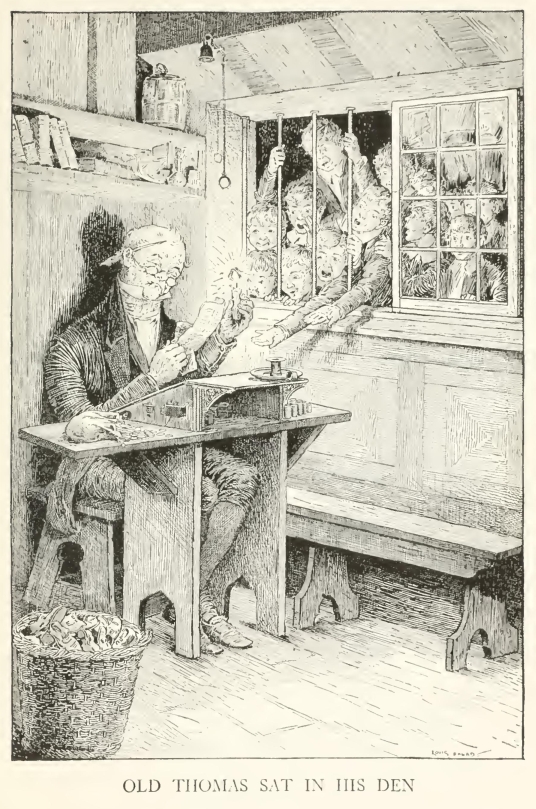
Original
“Thomas, do be quick; we shall never catch the Highflyer at Dunchurch.”
“That's your money all right, Green.”
“Hullo, Thomas, the Doctor said I was to have two pound ten; you've only given me two pound.” (I fear that Master Green is not confining himself strictly to truth.) Thomas turns his head more on one side than ever, and spells away at the dirty list. Green is forced away from the window.
“Here, Thomas—never mind him; mine's thirty shillings.” “And mine too,” “And mine,” shouted others.
One way or another, the party to which Tom belonged all got packed and paid, and sallied out to the gates, the cornopean playing frantically “Drops of Brandy,” in allusion, probably, to the slight potations in which the musician and postboys had been already indulging. All luggage was carefully stowed away inside the coach and in the front and hind boots, so that not a hat-box was visible outside. Five or six small boys, with pea-shooters, and the cornopean player, got up behind; in front the big boys, mostly smoking, not for pleasure, but because they are now gentlemen at large, and this is the most correct public method of notifying the fact.
“Robinson's coach will be down the road in a minute; it has gone up to Bird's to pick up. We'll wait till they're close, and make a race of it,” says the leader. “Now, boys, half a sovereign apiece if you beat 'em into Dunchurch by one hundred yards.”
“All right, sir,” shouted the grinning postboys.
Down comes Robinson's coach in a minute or two, with a rival cornopean, and away go the two vehicles, horses galloping, boys cheering, horns playing loud. There is a special providence over school-boys as well as sailors, or they must have upset twenty times in the first five miles—sometimes actually abreast of one another, and the boys on the roofs exchanging volleys of peas; now nearly running over a post-chaise which had started before them; now half-way up a bank; now with a wheel and a half over a yawning ditch: and all this in a dark morning, with nothing but their own lamps to guide them. However, it's all over at last, and they have run over nothing but an old pig in Southam Street. The last peas are distributed in the Corn Market at Oxford, where they arrive between eleven and twelve, and sit down to a sumptuous breakfast at the Angel, which they are made to pay for accordingly. Here the party breaks up, all going now different ways; and Tom orders out a chaise and pair as grand as a lord, though he has scarcely five shillings left in his pocket, and more than twenty miles to get home.
“Where to, sir?”
“Red Lion, Farringdon,” says Tom, giving hostler a shilling.
“All right, sir.—Red Lion, Jem,” to the postboy; and Tom rattles away towards home. At Farringdon, being known to the innkeeper, he gets that worthy to pay for the Oxford horses, and forward him in another chaise at once; and so the gorgeous young gentleman arrives at the paternal mansion, and Squire Brown looks rather blue at having to pay two pound ten shillings for the posting expenses from Oxford. But the boy's intense joy at getting home, and the wonderful health he is in, and the good character he brings, and the brave stories he tells of Rugby, its doings and delights, soon mollify the Squire, and three happier people didn't sit down to dinner that day in England (it is the boy's first dinner at six o'clock at home—great promotion already) than the Squire and his wife and Tom Brown, at the end of his first half-year at Rugby.
Original
CHAPTER VIII—THE WAR OF INDEPENDENCE.
“They are slaves who will not choose Hatred, scoffing, and abuse, Rather than in silence shrink From the truth they needs must think; They are slaves who dare not be In the right with two or three.” —LOWELL, Stanzas on Freedom.
 Original
he lower-fourth form, in which Tom found himself at the beginning of the next half-year, was the largest form in the lower school, and numbered upwards of forty boys. Young gentlemen of all ages from nine to fifteen were to be found there, who expended such part of their energies as was devoted to Latin and Greek upon a book of Livy, the “Bucolics” of Virgil, and the “Hecuba” of Euripides, which were ground out in small daily portions. The driving of this unlucky lower-fourth must have been grievous work to the unfortunate master, for it was the most un